Medication Timing Assistant
Medication Timing Guide
Check the proper timing for your medication based on medical evidence
Medication Timing Information
Why Timing Matters
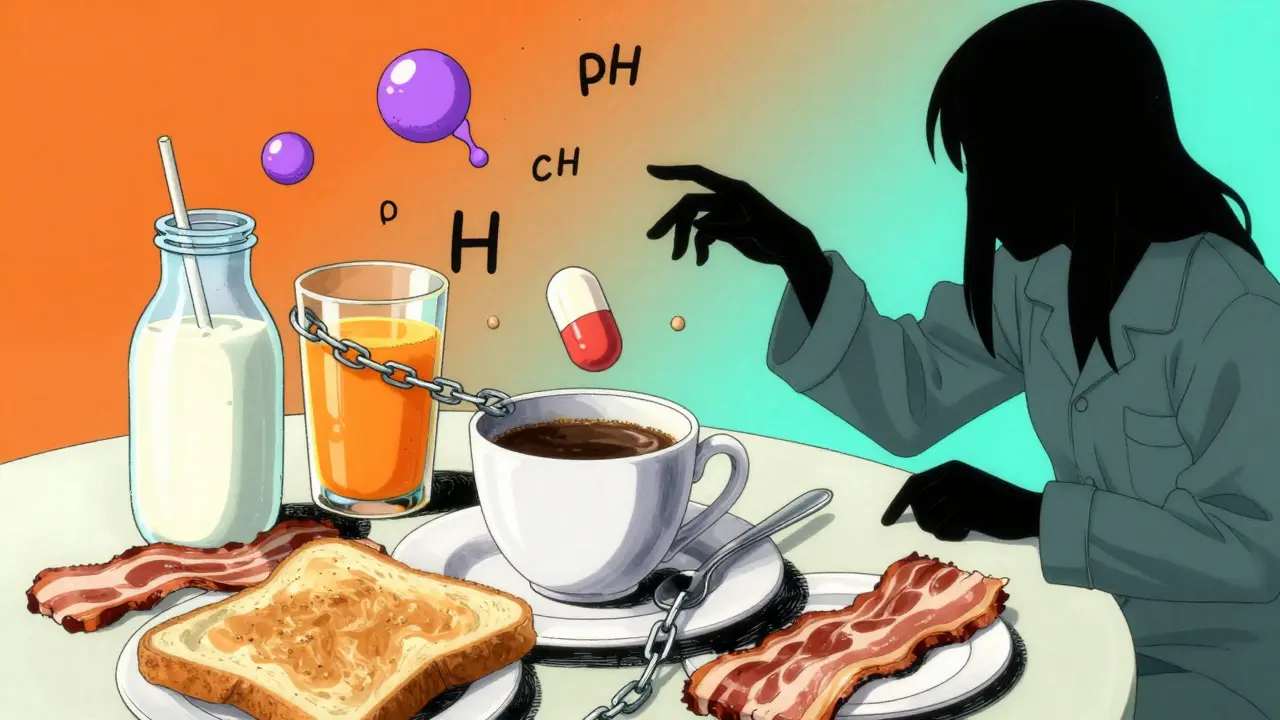
Food affects how your body absorbs medications. Gastric acid levels, bile flow, and enzyme activity change when you eat, which can increase or decrease drug effectiveness. For example:
- Empty stomach medications like levothyroxine need to be taken 1 hour before or 2 hours after meals
- Food-dependent medications like statins work better with a meal
- Drugs like NSAIDs require food to reduce stomach irritation
Common Questions
Yes. Water doesn't count as food. You can take empty-stomach medications with a full glass of water. Just avoid coffee, milk, juice, or anything with calories or minerals like calcium or iron within the required time window.
Don't panic. If you took a medication that should've been on an empty stomach, wait at least 2 hours after your meal and take your next dose as scheduled. Don't double up. If you're unsure, call your pharmacist. For food-required meds, if you forgot the food, eat a small snack and take the pill right away.
For most medications, consistency matters more than precision. But for thyroid meds like levothyroxine, taking it at the same time every day—especially on an empty stomach—keeps your hormone levels stable. For statins or blood pressure meds, being within a 1–2 hour window is usually fine.
Most people don’t think twice about popping a pill with their morning coffee or swallowing a pill right after lunch. But what if that tiny habit is making your medicine less effective-or even dangerous? The truth is, when you take your medication matters just as much as what you take. Whether you eat before, after, or during, food can change how your body absorbs drugs, how well they work, and whether you end up with side effects you didn’t sign up for.
Why Food Changes How Medicines Work
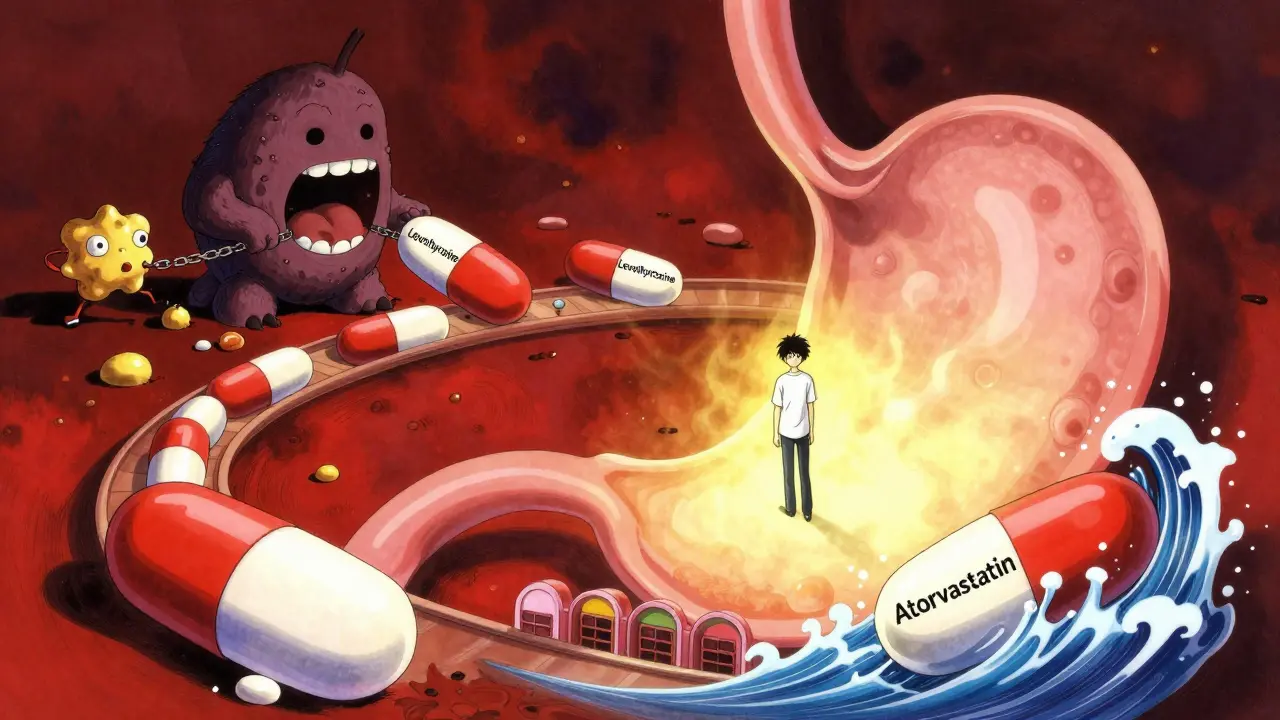
Your stomach isn’t just a passive container. When you eat, your body goes into digestion mode. Gastric acid levels rise, bile flows, enzymes activate, and food slows down how fast your stomach empties. All of this affects how drugs get into your bloodstream. Some medications need an acidic environment to dissolve properly. Food raises your stomach’s pH, making it less acidic. That can break down drugs like penicillin V before they’re absorbed, cutting their effectiveness by up to 40%. Other drugs are fat-soluble-like statins or certain antifungals. They need the fat and bile released during a meal to dissolve and be absorbed. Without food, they just pass through your system unused. Then there’s the binding problem. Calcium in dairy, iron in supplements, or even magnesium in antacids can latch onto antibiotics like tetracycline and doxycycline, forming a compound your body can’t absorb. That’s why you’re told to take these meds two hours before or after milk or multivitamins. It’s not a suggestion-it’s science.Medications That Must Be Taken on an Empty Stomach
Some drugs are so sensitive to food that even a small snack can slash their absorption. Here are the big ones:- Levothyroxine (Synthroid): This thyroid hormone replacement is absorbed poorly if taken with food, coffee, or even calcium-fortified orange juice. Studies show food can reduce absorption by 20% to 50%. Missing the timing means your TSH levels stay high, your energy stays low, and your body struggles to regulate metabolism.
- Alendronate (Fosamax): This osteoporosis drug can severely irritate your esophagus if it doesn’t move quickly through your stomach. Food delays gastric emptying, letting the pill sit and burn. Absorption drops by 60% if taken with food.
- Sucralfate (Carafate): It works by forming a protective coating over ulcers. If you eat before it coats the area, the food displaces it. That’s why you take it 1 hour before meals.
- Ampicillin: Food reduces peak blood levels by 35% and total exposure by 28%. That means the antibiotic might not kill all the bacteria, leading to treatment failure or resistance.
- Zafirlukast (Accolate): Used for asthma, this drug’s absorption drops 40% with food. Taking it with a meal can mean more wheezing and more rescue inhaler use.
- Omeprazole and Esomeprazole: These proton pump inhibitors block acid production. But they only work if they’re in your system before your stomach starts reacting to food. Take them 30-60 minutes before breakfast for best results.
Medications That Need Food to Work Right
Other drugs are like a key that only turns when there’s grease in the lock-food makes them work better.- NSAIDs (Ibuprofen, Naproxen): These painkillers can cause stomach ulcers. Taking them with food cuts that risk by 50-70%. In 2020, over 10,000 people were hospitalized each year in the U.S. from NSAID-related GI bleeding-many of which could’ve been prevented by just eating first.
- Aspirin (high-dose): For pain or inflammation, not heart protection, aspirin causes stomach irritation in 25% of users on an empty stomach. With food, that drops to 8%.
- Duloxetine (Cymbalta): This antidepressant often causes nausea. Taking it with food lowers nausea rates by 30%. If you’re struggling with side effects, food might be the fix-not a dosage change.
- Atorvastatin and Simvastatin: These cholesterol-lowering statins absorb better with food. But here’s the catch: grapefruit juice is a no-go. It can spike blood levels by 300-500%, raising your risk of muscle damage (rhabdomyolysis) by 15 times.
- Griseofulvin: An old-school antifungal for nail infections. Food boosts absorption by 50%. Skip the meal, and the drug might not reach the infection at all.
The Science Behind the Rules
It’s not just about “food bad” or “food good.” The type of food matters too. A high-fat meal can delay stomach emptying by 90 to 120 minutes. That’s long enough to throw off timing for drugs like levothyroxine, where even a 30-minute delay can reduce hormone suppression by 22%. A light snack? Maybe not a problem. A bacon-and-eggs breakfast? That’s a whole different story. Gastric pH changes from 1-2 (very acidic) when empty to 3-5 after eating. That’s enough to degrade acid-sensitive drugs. Bile secretion triggered by fat helps dissolve fat-soluble drugs. Calcium, iron, and aluminum in food bind to certain antibiotics, making them useless. The FDA now requires drug makers to test new medications with both high-fat (800-1,000 calorie) and low-fat (250-300 calorie) meals. Over two-thirds of new drugs approved between 2018 and 2022 came with specific food instructions because of these tests. That’s not coincidence-it’s evidence.What Happens When You Ignore the Rules
People don’t mean to mess up. They’re tired. They’re busy. They forget. But the consequences are real. A 2022 patient survey found 65% of people take medications without paying attention to food timing. Of those, 41% noticed their meds weren’t working as well. Nearly 30% had worse side effects. For thyroid patients, taking levothyroxine with breakfast can make your medication feel like you’re missing a quarter of your doses. Your doctor might keep increasing your dose, thinking you’re non-compliant-when you’re just eating too soon. NSAID users who skip food are 73% more likely to report stomach pain. And for PPIs like Nexium, taking them after breakfast instead of before reduces ulcer healing rates from 93% to 67% in just eight weeks. On Reddit, users share stories like: “I took Synthroid with my coffee for two years. My TSH was always high. Then I switched to taking it at 4 a.m. and waiting 90 minutes. My levels normalized in three months.”
How to Get It Right Every Time
You don’t need to memorize every rule. Here’s how to make it simple:- Use the 2-1-2 Rule: For empty stomach meds, take them 2 hours after eating or 1 hour before. For food-required meds, take them during or within 30 minutes of a meal.
- Label your pill organizer: Use stickers or colored tape: red for “empty stomach,” green for “with food.” A 2022 study showed this improved adherence by 35%.
- Use a medication app: Apps like Medisafe and GoodRx send alerts for food timing. Users who used them reduced errors by 28%.
- Ask your pharmacist: Pharmacists give food-timing advice 92% of the time. Doctors? Only 45%. If you’re unsure, go straight to the pharmacy.
- Stagger your meds: If you take both empty-stomach and food-required drugs, space them out. Take levothyroxine at 7 a.m., then breakfast at 8 a.m., then your statin with it.
- Check the bottle: Look for “take on empty stomach” or “take with food.” If it’s not clear, ask.
What’s Changing in the Future
The good news? Science is catching up. New drug formulations are being designed to ignore food. Johnson & Johnson’s Xarelto Advanced uses a pH-controlled release that works whether you eat or not. University of Michigan researchers are testing nanoparticles that bypass stomach acid entirely-so levothyroxine works even with coffee. The FDA is also moving to drop food-effect testing for 37% of drugs where food doesn’t matter. That means faster generic approvals and lower prices. But here’s the catch: experts say 75% of current prescriptions still need careful timing. Even with new tech, knowing the basics will keep you safe for years to come.Bottom Line
Your medication isn’t just a pill. It’s a tool-and like any tool, it works best under the right conditions. Food isn’t the enemy. Ignorance is. If you take thyroid meds, antibiotics, NSAIDs, or statins, the timing matters. Don’t guess. Don’t assume. Ask your pharmacist. Write it down. Set a reminder. Your body will thank you.Can I take my medication with water if it says ‘empty stomach’?
Yes. Water doesn’t count as food. You can take empty-stomach medications with a full glass of water. Just avoid coffee, milk, juice, or anything with calories or minerals like calcium or iron within the required time window.
What if I forget and take my pill with food?
Don’t panic. If you took a medication that should’ve been on an empty stomach, wait at least 2 hours after your meal and take your next dose as scheduled. Don’t double up. If you’re unsure, call your pharmacist. For food-required meds, if you forgot the food, eat a small snack and take the pill right away.
Do I need to take my pill at the exact same time every day?
For most medications, consistency matters more than precision. But for thyroid meds like levothyroxine, taking it at the same time every day-especially on an empty stomach-keeps your hormone levels stable. For statins or blood pressure meds, being within a 1-2 hour window is usually fine.
Why do some pills say ‘take with food’ but don’t say what kind?
Usually, any food will do-unless there’s a specific warning like “avoid grapefruit.” For drugs like duloxetine or statins, a light meal with some fat is enough. You don’t need a full steak dinner. The goal is to trigger bile flow and reduce irritation, not to binge.
Can I take my medication with a smoothie or protein shake?
No, not if it’s supposed to be taken on an empty stomach. Smoothies and shakes contain calories, fat, protein, and often calcium or iron. They count as food. Even a green smoothie can interfere with levothyroxine or antibiotics. Stick to plain water if the label says “empty stomach.”
Is it okay to take multiple medications at once?
It depends. Some drugs interact with each other, not just food. For example, calcium supplements can block absorption of antibiotics and thyroid meds. Always check with your pharmacist before combining pills. When in doubt, space them out by 2 hours.
Wendy Claughton
January 17, 2026 AT 16:59I used to take my Synthroid with my morning coffee like a champ… until my TSH spiked to 12.5. 😅 Turns out, coffee + thyroid med = disaster. Now I take it at 5 a.m. with water, wait 90 minutes, then enjoy my latte. Life-changing. Seriously. 🙌
Stacey Marsengill
January 19, 2026 AT 04:32Wow. So now I’m supposed to be a scientist just to take a pill? 🤡 I’m tired of being guilt-tripped by my own medicine. Next they’ll tell me to bow to my ibuprofen before swallowing it.
Robert Davis
January 19, 2026 AT 21:41Actually, the FDA’s food-effect testing is mostly marketing fluff. Big Pharma just wants to sell you more expensive formulations. The real reason they tell you to take things on an empty stomach? So you’ll forget, then buy the ‘enhanced’ version. It’s a racket.
Eric Gebeke
January 20, 2026 AT 16:10You people are ridiculous. If you can’t follow basic instructions, maybe you shouldn’t be taking prescription meds at all. This isn’t a buffet. It’s medicine. Stop making excuses and read the label. I’ve been taking my statins with food for 12 years. No rhabdomyolysis. No drama. Just discipline.
Jake Moore
January 21, 2026 AT 00:56Biggest myth: ‘Take with food’ means ‘eat a full meal.’ Nope. A handful of almonds or a slice of toast is enough for statins or duloxetine. I used to eat bacon and eggs with my Cymbalta, felt nauseous. Switched to a banana-boom. No nausea. You don’t need a feast, just enough fat to trigger bile flow.
Praseetha Pn
January 21, 2026 AT 06:38Did you know the government hides the truth? Levothyroxine isn’t just affected by food-it’s designed to fail unless you’re on a 3 a.m. fasting schedule. Big Pharma and the FDA are in cahoots. Why? So you’ll keep buying more. And don’t get me started on calcium in milk-it’s a mind-control agent disguised as nutrition.
Nishant Sonuley
January 22, 2026 AT 23:02Look, I get it-timing matters. But let’s be real: most people are juggling jobs, kids, and chronic pain. We’re not robots. I take my levothyroxine with water at 7 a.m., then eat at 7:30. My TSH is normal. My doctor says it’s fine. Maybe the ‘rules’ aren’t as rigid as we’re told. Let’s stop shaming people for living in the real world.
Emma #########
January 24, 2026 AT 17:27Thank you for writing this. I’ve been so anxious about getting my meds right. This made me feel less alone. I used to take my ampicillin with yogurt because I thought probiotics helped. Now I know why I kept getting sick. 😔
Andrew McLarren
January 26, 2026 AT 01:48It is imperative to underscore the clinical significance of pharmacokinetic interactions between dietary components and pharmaceutical agents. The data presented herein is not merely anecdotal but is substantiated by randomized controlled trials and FDA-mandated bioequivalence studies. One must approach medication adherence with the rigor appropriate to a therapeutic intervention.
Andrew Short
January 27, 2026 AT 10:08People who take meds with food are lazy. They don’t care about their health. They want convenience over survival. That’s why America’s healthcare costs are through the roof. If you can’t follow a 30-minute window, you don’t deserve to be on medication.
christian Espinola
January 27, 2026 AT 16:13Correction: ‘Take on empty stomach’ means 1 hour before or 2 hours after. Not ‘whenever you feel like it.’ Also, ‘grapefruit juice’ is not a ‘warning’-it’s a lethal interaction. You’re not ‘being careful,’ you’re just not dead yet.
Chuck Dickson
January 28, 2026 AT 00:46Hey, if you’re new to this-congrats on caring enough to read this post. Seriously. Most people just swallow pills and hope for the best. You’re already ahead. Use the 2-1-2 rule. Set a phone alarm. Put colored stickers on your pillbox. You got this. And if you mess up? Don’t beat yourself up. Just reset and try again tomorrow. Progress > perfection.
Robert Cassidy
January 29, 2026 AT 01:19They tell you to take meds on an empty stomach… but who controls the food supply? Who owns the pharmacies? Who profits when you take the wrong pill at the wrong time? Wake up. This isn’t about science-it’s about control. They want you dependent. They want you confused. Don’t be their puppet.
Dayanara Villafuerte
January 30, 2026 AT 21:06Just took my griseofulvin with a peanut butter sandwich. Felt like a rebel. 😎 Also, I’m from the Philippines-we’ve been doing this for decades. Your ‘science’ is just Western bureaucracy with a lab coat. 🌏💊
Andrew Qu
February 1, 2026 AT 05:11Wendy (first comment)-your story is why I do what I do. I’m a pharmacist, and I see this every day. People think they’re ‘non-compliant’ when they’re just misinformed. You didn’t fail. You learned. That’s the whole point. Keep going. And if you ever need someone to ask, I’m here.