Steroid-Induced Osteoporosis Risk Calculator
Calculate Your Risk
Enter your steroid use details to estimate your fracture risk from long-term corticosteroid use.
Why Long-Term Steroids Put Your Bones at Risk
When you take corticosteroids like prednisone for months or years - whether for asthma, rheumatoid arthritis, or an autoimmune condition - your body pays a hidden price. Your bones start to weaken, often without warning. This isn’t just a side effect. It’s a well-documented medical condition called glucocorticoid-induced osteoporosis (GIOP) a form of secondary osteoporosis caused by long-term use of corticosteroids that leads to rapid bone loss and increased fracture risk. And it happens fast. Within the first three to six months of starting treatment, bone density can drop by 5% to 15%, especially in the spine. Fracture risk jumps by 70% to 100%. This isn’t rare. Between 30% and 50% of people on long-term steroids develop it.
The problem? Most people don’t realize it’s happening until they break a bone. A hip fracture from a simple fall, a collapsed vertebra from coughing - these aren’t accidents. They’re predictable outcomes of untreated bone loss. And here’s the cruel twist: steroids don’t just make bones brittle. They also make your body less able to respond to the one thing that should help: weight-bearing exercise. Studies show that the bone-strengthening effect of walking or lifting weights drops by about 25% in steroid users.
How Steroids Attack Your Bones
It’s not magic. It’s biology. Corticosteroids mess with your bone’s natural repair system. Normally, your body breaks down old bone (via cells called osteoclasts) and builds new bone (via osteoblasts). This balance keeps your skeleton strong. Steroids break that balance.
- They shut down osteoblasts - the cells that build bone - and even kill them off.
- They keep osteoclasts alive longer, so more bone gets broken down.
- They reduce how much calcium your gut absorbs from food - by about 30%.
- They make your kidneys flush out more calcium instead of reabsorbing it.
- They increase RANK ligand, a signal that tells bone-resorbing cells to go into overdrive.
Even worse, your bones stop responding to mechanical stress. That means walking, climbing stairs, or doing light resistance training won’t help as much as it used to. The result? A skeleton that’s thinning from the inside out, especially in the spine and hips - the very places that fracture most easily.
Who’s at Risk - And When
Not everyone on steroids gets GIOP. But if you’re taking the equivalent of 2.5 mg of prednisone daily for three months or longer, you’re in the high-risk group. That’s the threshold set by the Bone, Body and Calcium (BBC) working group and the American College of Rheumatology. Risk jumps again if you’re on 7.5 mg or more per day - fracture risk doubles at that level.
Here’s what the numbers show:
- Each extra 1 mg of prednisone per day leads to a 1.4% annual drop in spine bone density.
- And a 0.9% drop in hip bone density every year.
- Fractures happen fastest in the first year - half of all steroid-related fractures occur within 12 months of starting treatment.
Men are at higher risk than women, but they’re far less likely to get checked. Studies show only 44% of men on long-term steroids receive any prevention advice, compared to 76% of women. That’s a dangerous gap. Age doesn’t matter as much as dose and duration. Even young adults on chronic steroids can develop severe bone loss.
The Foundation: Lifestyle Changes That Actually Work
Before you reach for a pill, there are three things you must do - and they’re backed by high-quality evidence.
- Use the lowest possible steroid dose for the shortest time. Reducing your daily prednisone from over 7.5 mg to 7.5 mg or less cuts fracture risk by 35% within six months. Talk to your doctor about tapering - don’t stop abruptly, but don’t stay on more than you need.
- Move your body every day. Walk 30 minutes on most days. Do light strength training twice a week. Even standing while brushing your teeth helps. This isn’t about intensity - it’s about consistency. And yes, it still helps, even if the effect is 25% weaker than in non-users.
- Quit smoking and limit alcohol. Smoking cuts fracture risk by 25-30% if you stop. Alcohol? Keep it under three units per day. More than that speeds up bone loss.
These aren’t suggestions. They’re medical necessities. And yet, only about 40% of patients on long-term steroids get proper counseling on these basics. That’s a system failure.
Calcium and Vitamin D: Non-Negotiable
You can’t fix steroid-induced bone loss without enough calcium and vitamin D. But most people get it wrong.
The Cleveland Clinic recommends:
- 1,000 to 1,200 mg of calcium daily - mostly from food (dairy, leafy greens, fortified foods), with supplements only if you fall short.
- 600 to 800 IU of vitamin D daily - but many need 800 to 1,000 IU to reach optimal blood levels (at least 20 ng/mL).
Why? Because steroids block calcium absorption. And without enough vitamin D, your body can’t use the calcium you take in. A 2021 study found that taking 1,000 mg calcium and 500 IU vitamin D daily prevented 0.72% annual bone loss in the spine - while the placebo group lost 2% per year. That’s a massive difference.
But here’s the catch: adherence drops to 40% after a year. Why? Because people forget. Or think it’s not urgent. Or assume the doctor will handle it. Don’t assume. Track your intake. Use a pill organizer. Set phone reminders. This is as important as taking your steroid.
Medications That Save Bones
If you’re on long-term steroids and have other risk factors - age over 50, prior fracture, low BMD - you need more than diet and exercise. You need medication.
The BBC guidelines and the American College of Rheumatology agree: bisphosphonates are first-line. Why?
- Risedronate (5 mg daily or 35 mg weekly) reduces spine fractures by 70% and other fractures by 41%.
- Zoledronic acid (5 mg IV once a year) increases spine bone density by 4.5% in 12 months - placebo only gained 0.5%.
- Denosumab (60 mg every 6 months) boosts spine BMD by 7% in a year.
- Teriparatide (daily injection) is the strongest option - increases spine BMD by 9.1% in 12 months and is especially recommended for people with T-scores below -2.5 or prior fractures.
Teriparatide isn’t just stronger - it’s 2.3 times more effective than alendronate in high-risk steroid users. But it’s expensive and requires daily injections. So it’s reserved for severe cases.
Most people start with risedronate or zoledronic acid. They’re effective, affordable, and well-studied. Side effects? Mostly mild stomach upset. If you can’t tolerate oral bisphosphonates, IV zoledronic acid is a solid alternative.
The Big Problem: Nobody’s Getting the Care They Need
Here’s the shocking truth: despite clear guidelines, only 15% of people on long-term steroids get full, guideline-concordant care. That means almost 9 out of 10 people are flying blind.
Studies show:
- Only 31% had a bone density scan (DXA) - the gold standard test.
- Only 40% had calcium supplementation documented.
- Only 37% had vitamin D levels checked or supplemented.
- Only 62% received any form of prevention - counseling, medication, or testing.
Why? Fragmented care. A rheumatologist prescribes steroids, but the primary care doctor doesn’t know. Patients don’t connect the dots. Many believe bone loss is just “what happens with steroids” - and that it’s inevitable. It’s not.
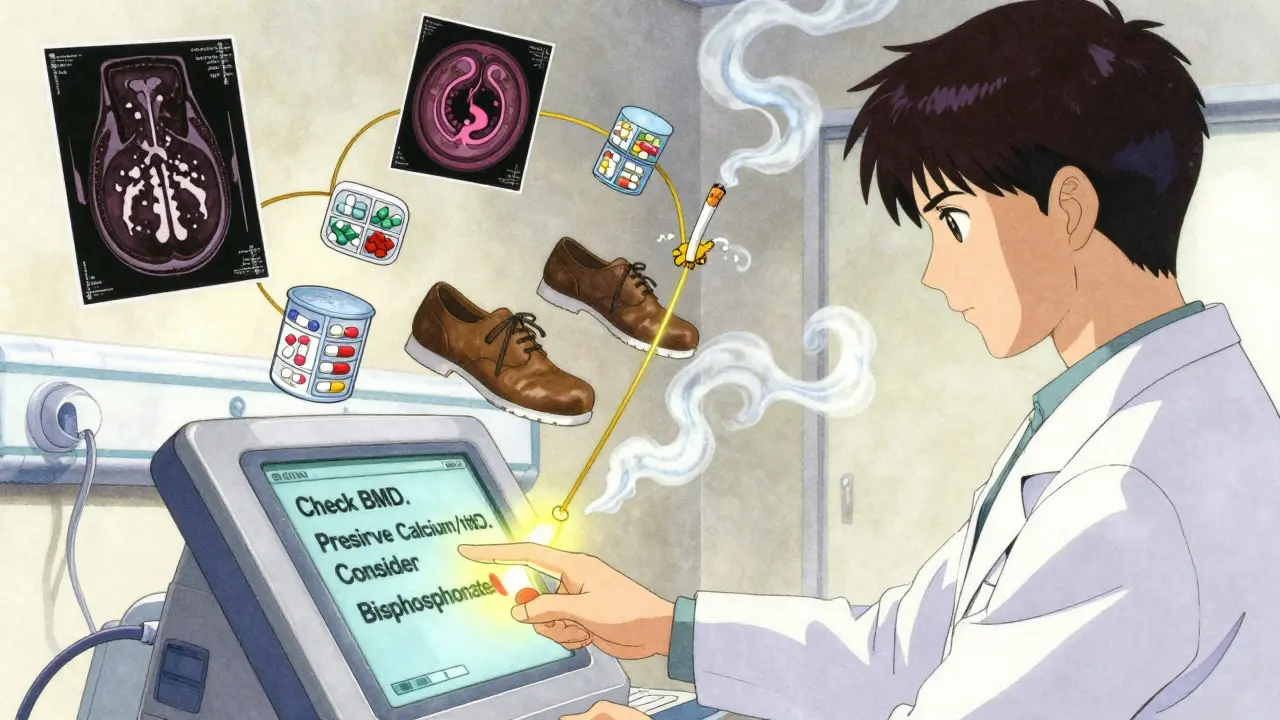
One hospital system in the U.S. Veterans Affairs network fixed this by adding automatic alerts to electronic records. When a steroid prescription hit 2.5 mg/day for 3 months, the system popped up a reminder: “Check BMD. Prescribe calcium/vitamin D. Consider bisphosphonate.” Result? Prevention rates jumped from 40% to 92%.
Pharmacist-led education programs did the same thing - increasing care from 35% to 85% in six months. You don’t need magic. You need systems.
What You Should Do Right Now
If you’re on long-term steroids, here’s your action list:
- Ask your doctor: “What’s my fracture risk?” Use the FRAX tool adjusted for steroid dose - it’s free and widely used.
- Get a bone density scan (DXA) - now, not later. Repeat every 1-2 years if you’re still on steroids.
- Start calcium (1,000-1,200 mg/day) and vitamin D (800-1,000 IU/day) if you’re not already.
- Move daily. Walk. Lift light weights. Don’t sit still.
- Stop smoking. Cut alcohol.
- If you’re on ≥2.5 mg prednisone daily for 3+ months, ask about bisphosphonates - risedronate or zoledronic acid are good starting points.
Don’t wait for a fracture to happen. The window for prevention is the first 3-6 months. After that, you’re playing catch-up.
What Your Doctor Should Be Doing
Doctors need better tools. The American College of Rheumatology says bone density testing should happen at treatment start - not after a fracture. And they should be reminded, not expected to remember.
Ask your doctor if they use:
- FRAX with steroid adjustment
- Electronic alerts for steroid prescriptions over 2.5 mg/day
- Standardized order sets for calcium, vitamin D, and bisphosphonates
If they don’t, bring this article. You’re not being difficult. You’re being smart.
Can I stop my steroids to protect my bones?
No - never stop steroids suddenly. Abruptly stopping can trigger adrenal crisis, a life-threatening condition. Instead, work with your doctor to lower your dose to the minimum needed to control your condition. Even reducing from 10 mg to 7.5 mg daily can cut fracture risk by 35%. The goal isn’t to stop, but to use the least amount for the shortest time.
Do I need a bone density scan if I feel fine?
Yes. Osteoporosis has no symptoms until you break a bone. That’s why it’s called a silent disease. A DXA scan measures bone density in your spine and hip - the two areas most affected by steroids. Waiting until you feel pain or have a fracture means damage is already done. Get tested at the start of therapy and repeat every 1-2 years.
Is walking enough exercise to protect my bones?
Walking helps - but it’s not enough on its own. Weight-bearing exercise like walking, stair climbing, or dancing is better than nothing. But adding light resistance training (like resistance bands or small dumbbells) twice a week gives you the best protection. Even 10 minutes of lifting light weights after your walk makes a measurable difference in bone strength over time.
Why do I need vitamin D if I’m already taking calcium?
Calcium can’t build bone without vitamin D. Steroids reduce your body’s ability to absorb calcium from food. Vitamin D helps your gut absorb it and tells your bones to store it. If your vitamin D level is below 20 ng/mL, you’re not getting the full benefit - even if you’re taking 1,200 mg of calcium. Most people need 800-1,000 IU daily to reach optimal levels. Get your level checked if you’re unsure.
Are bisphosphonates safe for long-term use with steroids?
Yes - and they’re the most studied option for steroid-induced osteoporosis. Risedronate and zoledronic acid have been tested in hundreds of patients on long-term steroids. They reduce fractures without increasing serious side effects. The most common issue is mild stomach upset, which often improves with proper dosing (take on empty stomach with water, stay upright for 30 minutes). If you can’t tolerate oral bisphosphonates, IV zoledronic acid or denosumab are safe alternatives.
Final Thought: This Is Preventable
Glucocorticoid-induced osteoporosis isn’t a side effect you have to live with. It’s a medical condition with proven, effective solutions. The tools are there: blood tests, scans, supplements, exercise, and medications. The problem isn’t lack of knowledge - it’s lack of action. Don’t wait for a fracture to wake you up. Talk to your doctor. Get tested. Start the basics today. Your bones will thank you years from now.
Milad Jawabra
March 5, 2026 AT 21:58Bro, I was on prednisone for 2 years for my autoimmune stuff. Didn’t even know my bones were crumbling until I slipped on ice and cracked a vertebra. 😬
Started calcium + D3, walked every damn day, and did 10 mins of dumbbells twice a week. No magic, just consistency.
Now I’m off steroids and my DXA scan improved by 8%.
Stop waiting for a fracture. Start moving today. Your future self will high-five you.
Megan Nayak
March 6, 2026 AT 19:08Let’s be real - this whole ‘bone loss’ narrative is just Big Pharma’s way of selling bisphosphonates. You know what strengthens bone? Gravity. And sunlight. And not being poisoned by synthetic hormones.
Why not just stop steroids entirely? Oh right - because the system wants you dependent.
Who benefits? Not you. Not your bones. The pharmaceutical-industrial complex does.
Jane Ryan Ryder
March 7, 2026 AT 23:59Oh wow. So taking medicine to stay alive is now a crime against your skeleton?
Next you’ll tell me oxygen causes lung cancer.
At least I didn’t die from my disease. Guess I’ll just stop taking my pills and let my immune system ‘do its thing’ while I’m in a wheelchair at 35. Thanks for the advice, Dr. Optimist.
Callum Duffy
March 8, 2026 AT 00:34While the clinical evidence presented is robust and methodologically sound, one must consider the systemic fragmentation in primary care delivery that impedes guideline adherence.
It is not a failure of patient awareness, but rather a failure of interprofessional coordination.
The VA model demonstrates that algorithmic prompting within EHRs can yield dramatic improvements in preventive care uptake.
One might posit that the root issue lies not in individual behavior, but in institutional architecture.
Chris Beckman
March 9, 2026 AT 20:43so like… i’ve been on 5mg prednisone for 18 months and i just started taking calciuim pills last week??
wait no i think i was taking them but forgot to take them for like 3 months
and i walk my dog every day so that counts right??
also i smoke like 2 a day and drink 3 beers on fri nights
is it too late??
Levi Viloria
March 9, 2026 AT 23:45There’s a quiet dignity in the way our bodies adapt - even under chemical assault.
Our bones, like our spirits, don’t break because they’re weak.
They break because we stopped listening.
Walking isn’t exercise. It’s communion with gravity.
Calcium isn’t a supplement. It’s a promise to your future self.
And taking that pill every morning? That’s not compliance.
That’s rebellion against neglect.
Every step, every dose, every sunlit minute - it’s a whisper that says: I am still here.
And that’s worth more than any scan.
Richard Elric5111
March 11, 2026 AT 05:07The ontological paradox of glucocorticoid-induced osteoporosis resides not in the pharmacokinetics of prednisone, but in the epistemological dissonance between medical knowledge and human behavior.
One may possess perfect understanding of the mechanism - the suppression of osteoblasts, the upregulation of RANK ligand - yet still fail to ingest 1,000 mg of calcium.
This is not ignorance. It is existential inertia.
And it is the true epidemic.
Dean Jones
March 12, 2026 AT 03:19Look, I get it. You’re scared of breaking a bone. But here’s what nobody tells you - your body doesn’t care about your DXA scan numbers. It cares about survival. And steroids? They’re your body’s emergency override. They’re not the villain. They’re the firefighter who torches the house to save the family.
Now, sure, the rebuilding phase is brutal. Bone turnover slows. Calcium gets flushed. Osteoblasts go silent.
But here’s the kicker - your body still remembers how to rebuild. It’s not dead. It’s just on pause.
And guess what wakes it up? Movement. Not just walking. Not just lifting. But *consistent, daily, non-negotiable* load. Even if it’s 25% less effective. Even if it feels pointless. You do it anyway.
Because bone isn’t a static structure. It’s a conversation. And if you stop talking to it, it stops answering.
So talk. Every day. Even when you’re tired. Even when you don’t feel like it. Even when your doctor forgets to mention it.
Because your spine doesn’t care about your excuse. It only cares about your effort.
Betsy Silverman
March 13, 2026 AT 20:45I’m a nurse and I’ve seen so many patients ignore this. One guy, 48, on 10mg prednisone for lupus - didn’t get a scan for 3 years. Broke his hip getting out of bed. He said, ‘I didn’t think it’d happen to me.’
It happens to everyone.
Just start with calcium and vitamin D. Get a walking buddy. Set a reminder. It’s not hard. You don’t need to be perfect. Just show up.
And if your doctor doesn’t bring it up? Ask. Politely. But firmly.
We’re all just trying to live. Don’t let a side effect steal your future.
Ivan Viktor
March 15, 2026 AT 00:49So you’re telling me I gotta walk, take pills, quit smoking, drink less, get scanned, and beg my doctor for meds… just because I’m on steroids?
Man. I just wanted to breathe.
Guess I’ll just lie on the couch then. 😅