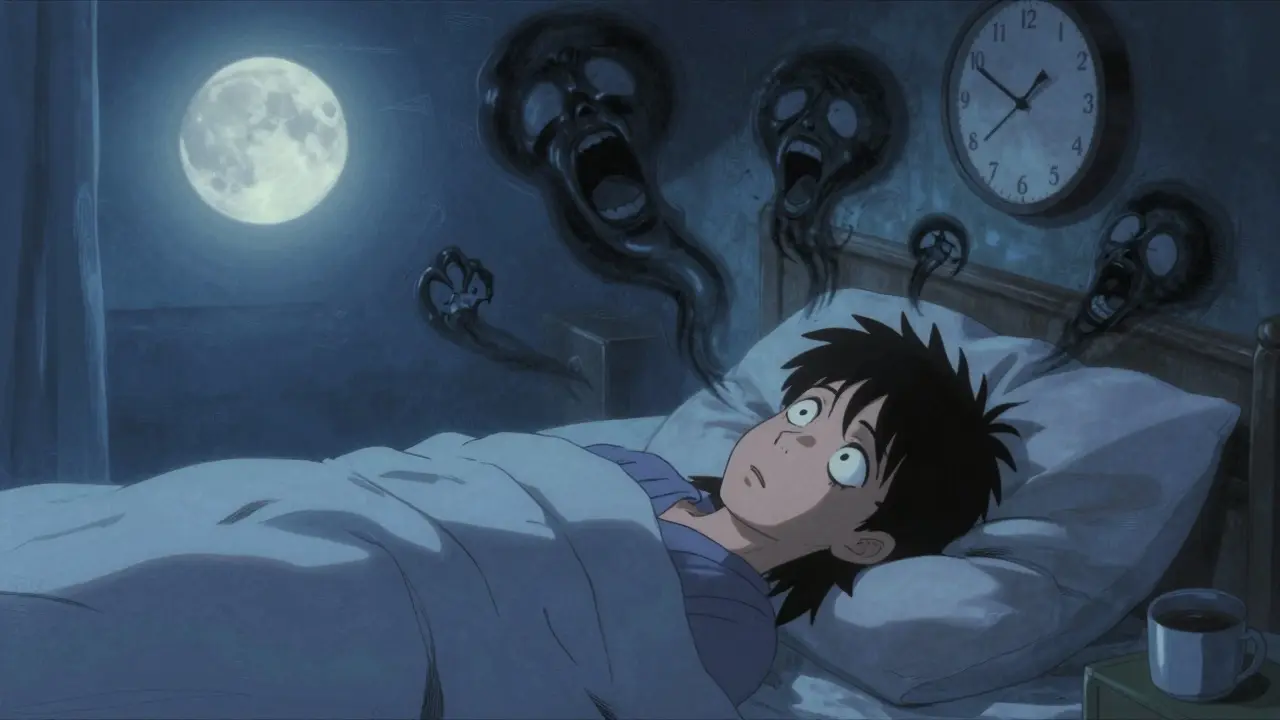
Imagine waking up and immediately fearing you’ve hit someone with your car - even though you were parked at home. Or spending two hours checking the stove ten times because the thought of a fire feels unbearable. These aren’t just bad thoughts. They’re intrusive thoughts - and for people with Obsessive-Compulsive Disorder (OCD), they’re relentless, terrifying, and impossible to shake off with logic alone.
OCD isn’t about being neat or organized. It’s a neurobiological condition where the brain gets stuck in a loop: an unwanted thought pops up, triggers intense fear or disgust, and the person tries to silence it by doing something - washing hands, checking locks, repeating phrases - only for the thought to come back stronger. This cycle doesn’t stop. It grows. And over time, it steals hours, relationships, jobs, and peace.
What Really Happens in the Brain with OCD?
Neuroscience has shown that OCD isn’t a character flaw or a sign of weakness. Brain scans reveal overactivity in two key areas: the orbitofrontal cortex (the part that detects errors) and the caudate nucleus (which helps switch between thoughts). When someone with OCD has an intrusive thought - like imagining pushing someone in front of a train - these areas light up like a fire alarm going off. But the brain’s brake system, the prefrontal cortex, doesn’t engage properly. So instead of saying, “That was just a thought,” the brain screams, “Danger! Do something now!”
That’s why people with OCD know their thoughts are irrational - but still feel powerless. A mother might have a flash of harming her baby, and even though she loves her child more than anything, the thought feels so real and terrifying that she avoids holding the baby. A student might fear they’re gay, despite being in a long-term relationship with a woman, and spend hours mentally reviewing past interactions to “prove” their orientation. These aren’t desires. They’re intrusions. And they’re ego-dystonic - meaning they feel alien, like someone else’s voice inside your head.
The Most Common Types of Intrusive Thoughts
Intrusive thoughts in OCD don’t happen randomly. They cluster into themes that are surprisingly common:
- Contamination (25% of cases): Fear of germs, chemicals, or “dirty” surfaces. People avoid doorknobs, public restrooms, or even shaking hands. Some wash their hands until they bleed.
- Harm (20-25%): Fear of hurting others - intentionally or by accident. Thoughts like “What if I stab my roommate?” or “Did I run over a pedestrian and not notice?” are common. These people often avoid knives, driving, or being near children.
- Symmetry and ordering (15-20%): Needing things arranged perfectly. Books must be aligned, socks paired, tiles counted. The anxiety spikes if something is off by even a millimeter.
- Taboo thoughts (10-15%): Sexual, religious, or identity-related obsessions. “What if I’m a pedophile?” “What if I blaspheme God?” “What if I’m not really who I think I am?” These thoughts cause deep shame, and many suffer in silence for years.
It’s crucial to understand: having these thoughts doesn’t mean you’ll act on them. In fact, people with OCD are far less likely to act on violent thoughts than the general population. The distress comes from the meaning they assign to the thought - not the thought itself.
Compulsions: The Temporary Fix That Makes Everything Worse
Compulsions are the brain’s desperate attempt to quiet the noise. They’re not habits. They’re survival tactics.
- Checking locks, stoves, or appliances - sometimes 30+ times a night.
- Washing hands until skin cracks - up to 100 times a day.
- Counting steps, tapping walls, repeating words silently - to “cancel out” bad thoughts.
- Reassurance-seeking: asking the same question over and over to confirm nothing bad happened.
- Mental rituals: praying, reviewing conversations, mentally “erasing” thoughts.
These rituals give a brief sense of relief - maybe 10 seconds. Then the thought returns. And the next time, it’s louder. The brain learns: “If I do this ritual, the danger goes away.” So it demands more. And more. One Reddit user shared that their checking rituals took 4 hours daily - until they lost their job. Another said they couldn’t tell anyone about their taboo thoughts for seven years because they were too ashamed.

Why ERP Therapy Is the Only Treatment That Works Long-Term
Traditional talk therapy often makes OCD worse. Talking about fears, analyzing them, or trying to “reassure” yourself just feeds the cycle. Medications like SSRIs (fluoxetine, sertraline) help about half of patients - but symptoms often return if you stop taking them. And side effects like nausea, weight gain, or emotional numbness push many to quit.
Enter Exposure and Response Prevention (ERP) - the gold-standard treatment backed by over 40 years of research. ERP doesn’t try to change your thoughts. It changes your relationship with them.
Here’s how it works:
- Exposure: You deliberately face the thing that scares you - not to reduce fear, but to learn that fear fades on its own. Touch a doorknob. Don’t wash. Watch a news clip about violence. Don’t check. Say the feared thought out loud: “I might be a bad person.”
- Response Prevention: You stop the compulsion. No washing. No checking. No mental reviewing. No reassurance-seeking. Just sit with the anxiety.
At first, anxiety spikes. That’s normal. Your brain screams, “This is dangerous!” But after 30-60 minutes, the anxiety drops - naturally. No ritual needed. The brain learns: “I didn’t do anything. I didn’t die. I didn’t hurt anyone. The thought didn’t become real.”
Studies show 60-80% of people who complete ERP see major symptom reduction. And the gains last. Sixty-five percent still have improvement five years later. One 14-year-old went from 4-5 hours of daily compulsions to under 30 minutes after six months of ERP.
How ERP Is Done - Step by Step
ERP isn’t about jumping into the scariest situation. It’s a ladder.
A therapist helps you build a “fear hierarchy” - ranking triggers from least to most anxiety-provoking. For someone with contamination fears:
- Level 1: Touch a light switch (anxiety: 20/100)
- Level 2: Use a public restroom (anxiety: 50/100)
- Level 3: Shake hands with a stranger (anxiety: 70/100)
- Level 4: Touch a trash can, then eat a snack (anxiety: 90/100)
You start at level one. Stay exposed. Don’t wash. Let anxiety peak and fall. Repeat daily. Move up the ladder. Sessions last 60-90 minutes, once a week. Homework is 1-2 hours a day - no exceptions.
It’s hard. Really hard. Seventy percent of people feel worse in the first two weeks. One in four drop out. But those who stick with it? They get their lives back.

What If You Can’t Find a Therapist?
Only 10% of U.S. therapists are trained in ERP. In rural areas, it’s worse - 75% of counties have zero specialists. But help is still possible.
- Telehealth: 45% of OCD patients now get ERP online. Platforms like NOCD and Cerebral offer licensed ERP therapists via video.
- Digital tools: The FDA-approved nOCD app guides users through ERP exercises. A 2022 study found it helped 55% of mild cases reduce symptoms.
- Self-guided ERP: Books like “The OCD Workbook” by Bruce Hyman or “Freedom from OCD” by Jonathan Grayson offer structured protocols. They’re not a replacement for therapy - but they’re a lifeline if you can’t find one.
Insurance coverage is still patchy. Only 60% of major insurers cover telehealth ERP the same as in-person. But demand is rising. The International OCD Foundation’s annual conference grew from 500 attendees in 2010 to 3,500 in 2023 - and more therapists are training.
Hope Is Real - Even When It Feels Impossible
People with OCD are often terrified to speak up. They fear being judged as dangerous, broken, or crazy. But the truth is: you’re not alone. Over 1.2% of U.S. adults live with OCD. That’s millions. And most of them have had the same thoughts you’ve had.
ERP doesn’t erase intrusive thoughts. It teaches you to live with them - without letting them control you. You don’t need to be “cured.” You just need to stop fighting them. And that’s where freedom begins.
Early intervention is key. If you start ERP within two years of symptoms, your chance of major recovery doubles. Waiting 10 years? That’s when OCD steals your future.
Are intrusive thoughts normal? Do everyone have them?
Yes, almost everyone has occasional intrusive thoughts - like a flash of wanting to yell in a quiet room or imagining a car accident. The difference is how you react. People without OCD notice the thought, shrug, and move on. People with OCD get trapped in it - they judge it as dangerous, immoral, or proof they’re flawed. That’s what turns a normal thought into a spiral.
Can OCD be cured?
OCD isn’t usually “cured” in the traditional sense. But it can be managed effectively. ERP helps most people reduce symptoms by 60-80%. Many live symptom-free for years. The goal isn’t to never have a thought - it’s to stop letting it control your life. With consistent treatment, people return to work, relationships, and hobbies they thought they’d lost forever.
Is ERP scary? What if I can’t handle it?
ERP is hard - but it’s not dangerous. You’re in control. You and your therapist choose the exposure level. You can stop at any time. Most people feel worse in the first two weeks - anxiety spikes, sleep suffers, mood dips. That’s normal. It’s the brain resisting change. But after that, anxiety naturally drops. The key is sticking with it. Over 70% of people who finish ERP say it was the best decision they ever made.
What about medication? Can I just take pills instead of ERP?
SSRIs like fluoxetine can help reduce symptoms, but they don’t teach you how to respond to thoughts. Most people relapse after stopping medication. ERP changes how your brain works - it builds new pathways. Studies show ERP alone works better than medication alone. The best results? Combining ERP with medication - 80-85% response rate. But if you can’t do ERP, medication alone is still better than nothing.
I have “Pure O.” Can ERP help me if I don’t have visible compulsions?
Yes - and it’s often the most effective treatment. “Pure O” means your compulsions are mental: repeating phrases in your head, mentally reviewing events, praying to neutralize thoughts, or avoiding triggers. ERP works the same way. You expose yourself to the feared thought - “I might be gay” - and prevent the mental ritual. You sit with the discomfort. You don’t analyze. You don’t reassure. You just let it be. Over time, the thought loses its power. The DSM-5-TR now recognizes Pure O as a real and common form of OCD.
Prathamesh Ghodke
March 19, 2026 AT 13:15Just wanted to say this post nailed it. I’ve had OCD since I was 12, and no one ever explained it like this. The brain-as-fire-alarm analogy? Spot on. ERP saved my life. I went from avoiding all public spaces to hiking solo last month. It’s not easy, but it’s worth every second of discomfort. You’re not broken. You’re just wired differently.
MALYN RICABLANCA
March 20, 2026 AT 07:48OMG YES. 😭😭😭 This is the most accurate thing I’ve ever read about OCD. I’ve been silently screaming into the void for 14 years thinking I was the only one who had thoughts like ‘what if I strangle my cat while singing lullabies?’ and then I’d spend 3 hours mentally rehearsing ‘I didn’t do it, I didn’t do it, I didn’t do it’ until my brain felt like overcooked spaghetti. ERP is the only thing that didn’t make me want to crawl into a hole and die. Also, I now have a tattoo that says ‘THOUGHTS ARE NOT FACTS’ on my wrist. 💅✨
Kathy Underhill
March 21, 2026 AT 13:55The neuroscience explanation here is profoundly accurate. The orbitofrontal cortex’s hyperactivity combined with prefrontal inhibition failure creates a feedback loop that mimics a faulty alarm system. What’s rarely discussed is how the limbic system’s amygdala amplifies the perceived threat, making cognitive reappraisal ineffective without behavioral intervention. ERP works because it interrupts the reinforcement cycle-not by changing the thought, but by extinguishing the conditioned response. This is not psychology. It’s neuroplasticity in action.
Stephen Habegger
March 22, 2026 AT 09:25This gave me chills. I’ve watched my sister struggle for 8 years. She finally started ERP last year. She’s back at work. She hugged her niece for the first time in 5 years. No meds. No magic. Just courage and consistency. If you’re reading this and thinking you can’t do it-you already are. Keep going.
Kyle Young
March 23, 2026 AT 04:53It’s fascinating how the brain’s error-detection system becomes pathologically overactive in OCD. In evolutionary terms, it makes sense-hypervigilance to threats increased survival. But in modern environments, where the threats are abstract (e.g., ‘I might be a bad person’) rather than physical (e.g., predator nearby), this system becomes maladaptive. ERP essentially retrains the brain’s threat assessment algorithm through prolonged exposure without reinforcement. The fact that gains persist for years suggests structural synaptic changes. This isn’t just behavior modification-it’s neuroreprogramming.
cara s
March 23, 2026 AT 11:37I have to say, I’m genuinely moved by the clarity of this piece. The way it delineates the neurobiological underpinnings-specifically referencing the orbitofrontal cortex and caudate nucleus-demonstrates an exceptional level of scholarly rigor. I am particularly struck by the emphasis on ego-dystonicity, which is often misunderstood as mere ‘weirdness’ rather than a profound dissonance between self-concept and intrusive content. Furthermore, the delineation between compulsions as survival tactics rather than habits is a crucial distinction that deserves widespread dissemination. One cannot overstate the importance of ERP as a neuroplastic intervention. The data is unequivocal.
Alexander Pitt
March 24, 2026 AT 22:43ERP is the only evidence-based treatment that works long-term. SSRIs help with symptoms but don’t rewire the brain. I’ve seen clients go from housebound to traveling internationally in 6 months with consistent ERP. The key is exposure without ritual. No reassurance. No mental reviewing. Just sitting. The anxiety drops. Always. It’s biology, not magic. If you’re stuck, find a certified ERP therapist. Or use nOCD. Don’t wait.
gemeika hernandez
March 26, 2026 AT 12:14Ugh I hate when people act like OCD is just being tidy. My cousin thought she had it because she liked her socks matched. Then she started avoiding doorknobs and crying for 3 hours because she thought she’d killed someone in a dream. She didn’t even know what ERP was until she Googled ‘I think I’m a monster’ at 2 a.m. This post is truth. Stop romanticizing it. It’s hell.
Nicole Blain
March 27, 2026 AT 00:20Just wanted to say I’ve been doing ERP for 8 months and today I touched a bus handle and didn’t wash for 4 hours. I cried. But I didn’t run. I just sat there. And guess what? I didn’t die. I didn’t get sick. My brain just… chillaxed. 🙏✨ I’m not ‘cured’ but I’m free. Thank you for writing this.
Srividhya Srinivasan
March 28, 2026 AT 19:09This is all nonsense. OCD is caused by demonic possession. The brain doesn’t malfunction-it’s spiritually compromised. ERP is just a distraction from true healing: prayer, fasting, and exorcism. I’ve seen it firsthand. A woman in my church was ‘cured’ after 40 days of prayer and salt circles around her bed. Science is just another tool of the New World Order.
Sanjana Rajan
March 29, 2026 AT 01:18Why is this even a thing? People just need to stop being dramatic. I’ve had random thoughts too-like ‘what if I punch my boss?’-and I just laugh and move on. If you’re overthinking it, maybe you’re just anxious and need to go for a walk. Stop making it a medical condition. It’s just modern overthinking culture. Also, why are we giving money to therapists? Just meditate.
Kendrick Heyward
March 29, 2026 AT 09:18Look, I get it. ERP works. But let’s be real-how many people can afford 60 sessions? Insurance won’t cover it. Therapists are booked for a year. And don’t even get me started on the ‘homework’-who has time to touch trash cans daily while working 2 jobs? This post is inspiring, but it’s also privileged. Real people are stuck. We need systemic change, not just ‘try harder.’
Andrew Mamone
March 31, 2026 AT 01:00Love how this breaks down the science. Also, I’ve been doing ERP for 11 months. Today I said out loud, ‘I might be a pedophile,’ and didn’t check my browser history. No ritual. Just sat with it. Anxiety peaked at 9/10… then dropped to 3. Took 47 minutes. My brain finally got it: thoughts aren’t actions. Not a miracle. Just biology. 🙌