
Every year, millions of people lose their hearing-not from aging, not from illness, but from something completely preventable: too much noise. Whether you're working on a construction site, operating machinery, or standing front row at a rock concert, your ears are being exposed to sound levels that can permanently damage your hearing. And most of the time, you won’t even notice it until it’s too late.
What Counts as Dangerous Noise?
Noise isn’t just loud. It’s about how long you’re exposed and how intense it is. The key number to remember is 85 decibels (dBA). That’s the level at which experts say hearing damage can start to happen over time. For context, a vacuum cleaner runs at about 70 dBA. A lawnmower hits 90 dBA. A chainsaw? Around 110 dBA. A rock concert? Often 115-120 dBA.Here’s the math: every time the noise level goes up by 3 dBA, your safe exposure time cuts in half. At 85 dBA, you can be exposed for 8 hours. At 88 dBA, only 4 hours. At 91 dBA, just 2 hours. At 100 dBA-common in factories or near loud speakers-you shouldn’t be exposed for more than 15 minutes without protection. That’s the standard recommended by NIOSH, the U.S. agency focused on workplace safety. But here’s the problem: not all rules follow this.
Why OSHA and NIOSH Don’t Agree
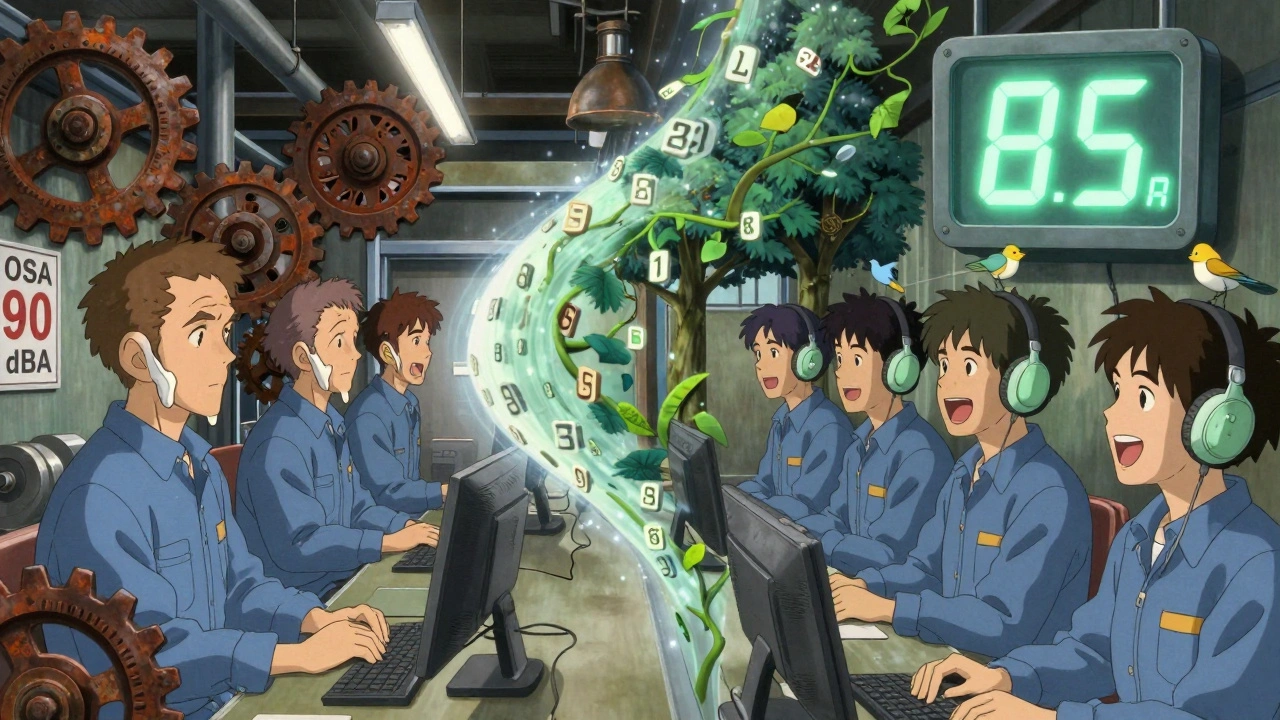
The Occupational Safety and Health Administration (OSHA) in the U.S. sets the legal limit at 90 dBA for an 8-hour workday. That’s 5 decibels higher than what NIOSH says is safe. Why does this matter? Because decibels work on a logarithmic scale. A 5-dB difference isn’t just a little louder-it’s nearly double the energy hitting your ears. OSHA’s rule allows for a 25% risk of hearing loss over a working lifetime. NIOSH’s 85 dBA limit aims to keep that risk below 8%.OSHA also uses a 5-dB exchange rate, meaning it lets you stay longer at higher noise levels than NIOSH. For example, at 100 dBA, OSHA says you can work 4 hours. NIOSH says 15 minutes. That’s a huge gap in protection. And it’s not just the U.S. The European Union uses 85 dBA as the action level and 87 dBA as the absolute limit-even after you add in ear protection. Australia matches NIOSH at 85 dBA with a 3-dB exchange rate. China does too. The UK is even stricter: they consider the protection from earplugs when setting limits, so the real exposure can’t exceed 87 dBA even if you’re wearing gear.
How Noise Damages Your Ears
Your inner ear has tiny hair cells that turn sound waves into signals your brain understands. These cells don’t grow back. Once they’re damaged by loud noise, the hearing loss is permanent. It doesn’t happen all at once. It builds up over years. You might not notice at first. You’ll start missing high-pitched sounds-birds singing, children’s voices, the chime of a doorbell. Then conversations in noisy rooms become hard. Eventually, you’ll need to turn up the TV or ask people to repeat themselves constantly.Studies show that workers exposed to 85-90 dBA for 20 years show clear signs of hearing loss on audiograms. And it’s not just factory workers. Musicians, DJs, construction crews, airport ground staff, and even farmers are at risk. In fact, 63% of professional musicians report some degree of hearing loss. At concerts, temporary hearing loss or ringing in the ears (tinnitus) after the show is common. That’s your body’s warning sign. If it happens often, permanent damage is likely.

What Employers Must Do (And Often Don’t)
Under OSHA rules, if noise hits 85 dBA over an 8-hour shift, employers must start a hearing conservation program. That includes:- Free hearing tests (audiograms) within 6 months of starting, then yearly
- Training on how to pick and wear earplugs or earmuffs properly
- Providing hearing protection at no cost
- Monitoring noise levels with sound meters
But here’s the catch: many employers skip the real fixes. Engineering controls-like putting up sound barriers, using quieter machines, or isolating noisy equipment-are the most effective. Yet they’re expensive. So instead, companies hand out foam earplugs and call it done. NIOSH found that without hands-on training, only 40% of workers wear hearing protection correctly. With training, that jumps to 85%. Properly fitted earplugs can reduce noise by 15-30 dB. But if they’re not inserted right, they might only block 5 dB. That’s the difference between protection and no protection at all.
Concerts Aren’t Safe Just Because They’re Fun
Recreational noise is the fastest-growing cause of hearing loss in young people. You don’t need a job to damage your ears. A two-hour concert at 115 dBA is the same as working 8 hours at 90 dBA. And unlike at work, no one’s monitoring your exposure. No one’s offering you a hearing test. No one’s reminding you to take a break.But change is coming. More festivals are now offering free, high-fidelity earplugs. The Lifehouse Festival saw 75% of attendees take them. Some venues install real-time sound displays so you can see the decibel level-just like a speedometer. Quiet zones with ambient noise around 70-75 dBA give people a place to rest their ears. Spotify and Apple Music now warn you when your headphones go above 85 dBA for too long. These aren’t just nice ideas-they’re science-backed.
Research from JAMA Otolaryngology shows smartphone apps can now measure noise with 92% accuracy. You don’t need a $1,000 meter to know if your environment is dangerous. Download a free app, stand where you normally are, and check the reading. If it’s over 85 dBA for more than a few minutes, it’s time to protect yourself.
What You Can Do Right Now
You don’t have to wait for your employer or the venue to act. Here’s what works:- Use hearing protection: Get musician-grade earplugs. They reduce volume without making music sound muffled. Brands like Etymotic, Loop, and Vibes cost $20-$40 and last years.
- Take breaks: Every hour, step away from the noise for 5-10 minutes. Let your ears reset.
- Lower headphone volume: If you can’t hear someone talking to you at arm’s length while wearing headphones, it’s too loud. Keep it below 60% of max volume.
- Track your exposure: Use a sound meter app on your phone. If you’re regularly above 85 dBA, start wearing protection.
- Get your hearing checked: Even if you feel fine, get a baseline audiogram. It’s the only way to know if you’re losing hearing.
The Bigger Picture: Why This Matters
Hearing loss isn’t just about missing music. It’s linked to loneliness, depression, cognitive decline, and even dementia. People with untreated hearing loss are 2x more likely to develop dementia. That’s not a coincidence. Your brain works harder to fill in missing sounds, and over time, it wears out.Workplace hearing loss costs the U.S. over $1 billion a year in workers’ compensation. The hearing protection market is growing fast-$2.1 billion in 2023-because people are waking up. California already follows NIOSH’s stricter standard. The EU is pushing to extend workplace protections to concert staff. And the World Health Organization says noise-induced hearing loss is 100% preventable.
That’s the key point: no one has to lose their hearing. Not at work. Not at a concert. Not while listening to music. The science is clear. The tools exist. The only thing missing is consistent action.
What’s Next?
By 2040, if every workplace and entertainment venue adopted the 85 dBA standard with a 3-dB exchange rate, the U.S. could prevent 240,000 cases of hearing loss every year. That’s more than the population of Adelaide. That’s your parents, your friends, your future self.Start today. Protect your ears like you protect your phone-from drops, from water, from overuse. Your hearing is the only one you’ve got. And once it’s gone, there’s no reset button.
What noise level is considered dangerous for hearing?
Any noise at or above 85 decibels (dBA) over an 8-hour period can cause permanent hearing damage. For every 3-dB increase, safe exposure time halves. At 100 dBA, you should not be exposed for more than 15 minutes without protection. This is the standard recommended by NIOSH and followed in Australia, the EU, and China. OSHA’s legal limit is higher at 90 dBA, but it offers less protection.
Do earplugs really help at concerts?
Yes, and not just any earplugs-musician-grade ones. These reduce volume evenly across frequencies so music still sounds clear, just quieter. They typically lower noise by 15-20 dB. Foam earplugs from the drugstore can work, but they often muffle sound too much and don’t fit well. High-fidelity earplugs cost $20-$40 and last years. Many festivals now give them out for free, and studies show 75% of people use them when available.
Can I check my noise exposure at home?
Yes. Free smartphone apps like NIOSH’s Sound Level Meter or Decibel X can measure noise with 90%+ accuracy compared to professional tools. Just hold your phone where your ear would be and check the reading. If it’s consistently above 85 dBA, you’re at risk. Use this to decide when to wear protection-even during everyday activities like mowing the lawn or using power tools.
Why do some workplaces still use 90 dBA instead of 85 dBA?
It’s mostly about cost and outdated regulations. OSHA’s 90 dBA limit is the legal minimum in the U.S., and many employers follow only what’s required, not what’s safer. Switching to 85 dBA means more training, better equipment, and sometimes new machinery-all of which cost money. But the long-term savings from fewer hearing loss claims and workers’ compensation payouts make it worthwhile. States like California are already moving to the safer standard.
Is hearing loss from noise reversible?
No. Once the hair cells in your inner ear are damaged by loud noise, they don’t regenerate. Temporary ringing or muffled hearing after a concert is a warning sign-it means damage has already occurred. Repeated exposure leads to permanent hearing loss. The good news? It’s 100% preventable. Use protection, take breaks, and monitor your exposure. Once you lose it, you can’t get it back.
How often should I get my hearing tested?
If you’re regularly exposed to noise above 85 dBA-whether at work or at concerts-you should get a baseline hearing test within six months of first exposure. After that, annual tests are recommended. These tests detect early signs of hearing loss, especially at the 3,000-4,000 Hz frequencies where noise damage usually starts. Even if you feel fine, testing is the only way to catch problems before they affect your daily life.
Evelyn Pastrana
December 10, 2025 AT 06:05My cousin works at a warehouse and they hand him foam plugs like they’re candy at a parade. He says he can’t even hear his own thoughts after a shift. No one cares until you can’t hear your kid say ‘I love you’ for the first time.
Lisa Whitesel
December 10, 2025 AT 22:57Simran Chettiar
December 12, 2025 AT 16:08Richard Eite
December 13, 2025 AT 09:49Katherine Chan
December 14, 2025 AT 10:33Now I carry my Etymotics everywhere-even to the gym
It’s not about being paranoid, it’s about keeping your future self from yelling at the TV
Trust me your future self will thank you
Philippa Barraclough
December 15, 2025 AT 09:27Tim Tinh
December 16, 2025 AT 20:37music still sounded crisp but my ears didnt feel like they got hit with a hammer
cost like 30 bucks and i’ve had em for 2 years
if you’re even a little into music or loud places just get em
your brain will thank you later
Ruth Witte
December 18, 2025 AT 13:21Get earplugs. Take breaks. Use the app. Your ears are NOT replaceable.
Stop waiting for someone else to fix it.
Protect your hearing like it’s your last iPhone.
Katherine Rodgers
December 18, 2025 AT 13:46Lauren Dare
December 19, 2025 AT 14:18Engineering controls? Too expensive.
Training? Too much work.
So we'll just rely on your self-discipline to do the right thing while we profit off your sensory degradation.
Lola Bchoudi
December 20, 2025 AT 19:30OSHA’s 5-dB model is an artifact of 1970s industrial economics, not audiology.
When you're measuring cumulative noise dose, halving exposure time per 3-dB increase is mathematically sound.
Anything else is risk management disguised as regulation.
Taya Rtichsheva
December 21, 2025 AT 11:08he says he used to wear plugs but they were so uncomfortable he just stopped
so yeah the plugs need to be comfy or no one will use em
and no one talks about this enough
Christian Landry
December 21, 2025 AT 15:05it was at 94 dBA
so i turned it down
now my music sounds worse but my ears feel better
weird tradeoff but worth it 🤷♂️
Katie Harrison
December 22, 2025 AT 17:46