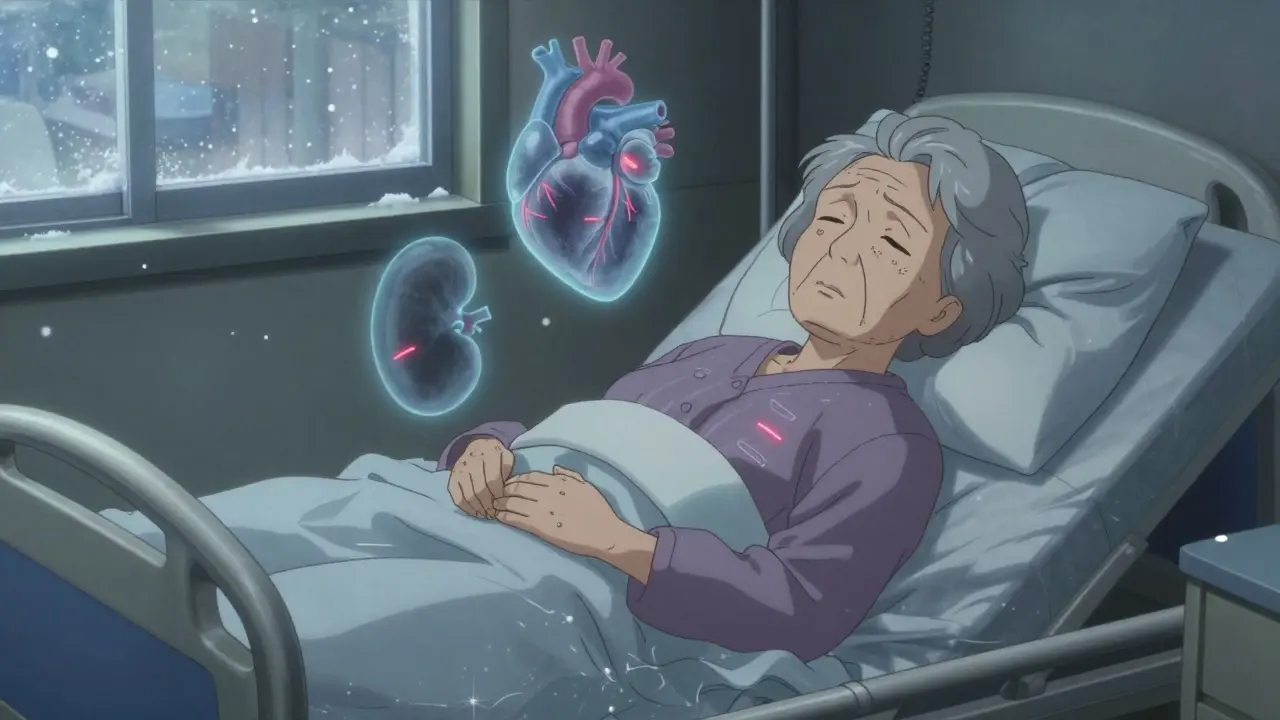
Myxedema coma isn’t just a rare complication of hypothyroidism-it’s a ticking clock. Every hour without treatment raises the risk of death by 10%. This isn’t a slow decline you can wait out. It’s a full-body shutdown triggered by years of untreated or poorly managed low thyroid function, and it hits hardest in older women during winter. The symptoms? Confusion so deep it looks like depression, body temperature dropping below 95°F, heart rate slowing to 40 beats per minute, and breathing so shallow it barely moves the chest. And here’s the brutal truth: many patients are sent home with a diagnosis of "old age" or "flu" before it’s too late.
What Actually Happens in Myxedema Coma?
When your thyroid stops producing enough T3 and T4, your body doesn’t just feel tired. Every system slows down. Your metabolism, your heart, your lungs, even your brain. In myxedema coma, this slowdown becomes catastrophic. The brain doesn’t get enough energy to stay alert-patients slip from sluggishness into unresponsiveness. The lungs can’t respond to rising carbon dioxide levels, so CO2 builds up, oxygen drops, and respiratory failure follows. The heart struggles to pump, blood pressure plummets, and kidneys start to fail.
What you see on the outside is often the least of it. Non-pitting swelling in the face, eyelids, and legs-classic myxedema-is just a sign of fluid leaking out of capillaries because thyroid hormone isn’t there to keep them tight. But inside, organs are starving. The liver can’t process toxins. The gut stops moving, leading to ileus and dangerous bloating. And sodium levels crash, often below 130 mmol/L, because the kidneys can’t concentrate urine properly. This isn’t just low thyroid-it’s multi-organ collapse.
The Diagnostic Triad: Three Red Flags You Can’t Ignore
There’s no single lab test that confirms myxedema coma. Instead, doctors look for three things together: altered mental status, hypothermia, and a clear trigger. That’s the triad. Missing one doesn’t rule it out. Missing two makes it deadly.
- Altered mental status: Not just drowsiness. It’s disorientation, slurred speech, hallucinations, or coma. In elderly patients, it often looks like dementia or depression. One study found 30% of older adults with myxedema coma had no classic symptoms-just confusion and fatigue.
- Hypothermia: Core temperature below 35°C (95°F). Not just feeling cold. This is a dangerously low internal temperature, even in a warm room. Many patients are found curled up, shivering weakly, or not shivering at all because their body has given up trying.
- Precipitating event: Something pushed the system over the edge. Infection (especially pneumonia or UTI) causes about half of cases. Stopping thyroid meds during a hospital stay? That’s a major red flag. Cold exposure, heart attack, stroke, or even sedatives can trigger it.
Don’t wait for all three. If you see two-especially hypothermia plus confusion-in someone with known or suspected hypothyroidism, treat it like a cardiac arrest. Time is tissue.
Why Myxedema Coma Is So Deadly (And Often Missed)
It’s not that doctors don’t know about it. It’s that they rarely see it. With only 0.2 to 0.6 cases per million people each year, most clinicians go their entire careers without treating one. And the symptoms? They mimic so many other things: stroke, sepsis, drug overdose, Alzheimer’s, even psychiatric illness.
Women over 60 are at highest risk-three times more likely than men. But men are more likely to be misdiagnosed. One study found men waited 40% longer for treatment because their symptoms were dismissed as "just aging." Patients with Hashimoto’s thyroiditis are especially vulnerable, especially if they’ve skipped doses or had their medication changed without monitoring.
And then there’s the cold. Myxedema coma spikes in winter. In Scandinavia, rates are 50% higher than in Mediterranean countries. Why? Cold forces the body to burn more energy to stay warm. If your thyroid isn’t working, you can’t generate heat. Your body shuts down instead.
One patient shared on a thyroid forum: "I wore three layers inside my heated house because I was always freezing. My doctor said I was just sensitive to air conditioning. Two weeks later, I was in the ICU with a temperature of 89°F and no memory of the last three days."
Emergency Protocol: What to Do When You Suspect Myxedema Coma
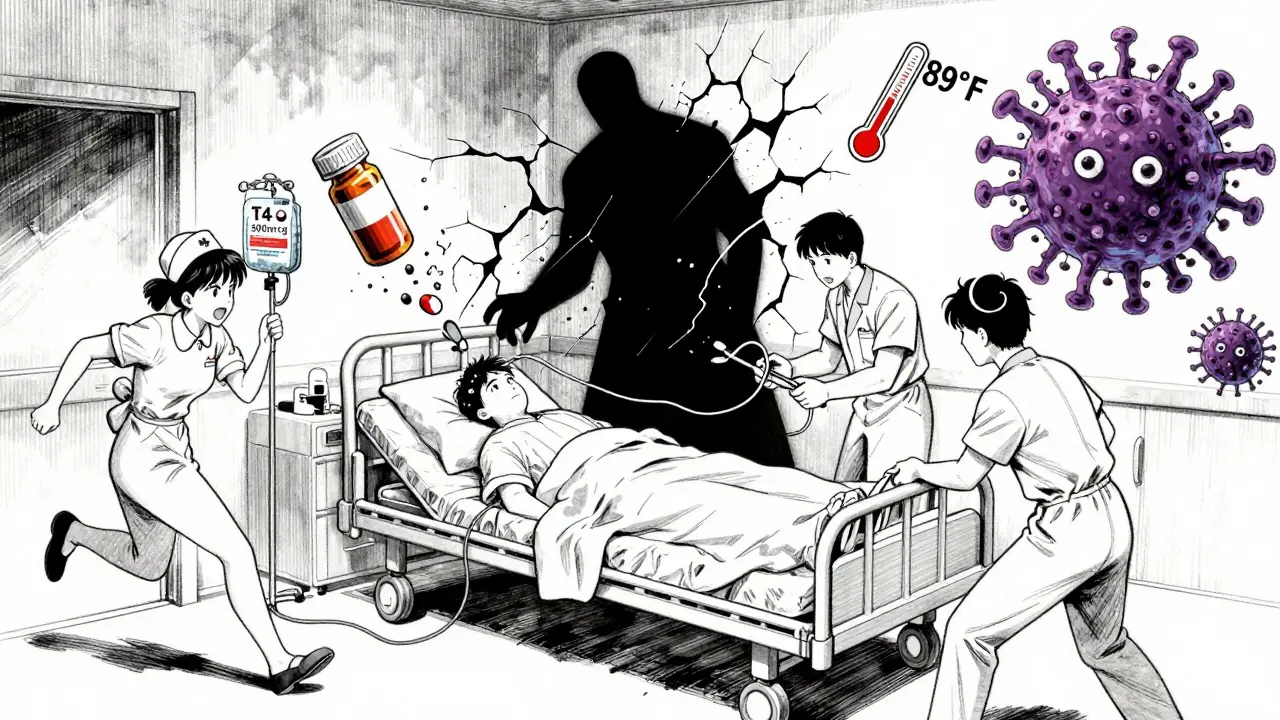
There’s no time for waiting on labs. If you suspect myxedema coma, start treatment within 30 minutes. The five-step protocol is simple, but every step matters.
- Secure the airway. Half to 70% of patients need intubation because their breathing is too slow or shallow. Don’t wait for oxygen saturation to drop. If respiratory rate is under 12 breaths per minute, prepare for intubation now.
- Give thyroid hormone immediately. Intravenous levothyroxine (T4) at 300-500 mcg as a loading dose. That’s 5-10 times a normal daily dose. In severe cases with heart problems, add liothyronine (T3) at 10-20 mcg every 8 hours. New guidelines now favor T3 first in cardiac compromise because it acts faster.
- Warm gently. No heating blankets. No hot water bottles. Active rewarming can cause dangerous drops in blood pressure. Use warm blankets, raise room temperature, and monitor core temperature every 30 minutes. Let the body warm slowly as hormone levels rise.
- Treat the trigger. If infection is suspected (and it usually is), start broad-spectrum antibiotics right away. Cover pneumonia and UTI pathogens. Don’t wait for cultures. If the patient had a recent hospital stay or stopped meds, assume infection until proven otherwise.
- Correct electrolytes carefully. Hyponatremia is common, but correcting sodium too fast can cause brain damage. Limit correction to 4-6 mmol/L in the first 24 hours. Give fluids only if dehydrated. Avoid glucose unless blood sugar is low-thyroid hormone is needed to process it.
Use the DIMES mnemonic to remember triggers: Drugs, Infection, Myocardial infarction/CVA, Exposure to cold, Stroke. If one of these is present, it’s likely the spark.
What Happens After Treatment?
When treatment starts early, improvement can be dramatic. Patients often wake up within 24-48 hours. Mental clarity returns. Temperature climbs. Heart rate normalizes. But recovery isn’t instant. The body needs weeks to fully reset.
After the emergency, patients are switched to oral levothyroxine at 1.6 mcg per kg of body weight daily. TSH levels are checked every 6-8 weeks. Many need lifelong higher doses than before. And they need education: never skip a dose. Never stop meds during hospital stays without endocrine consultation. Tell every doctor you have hypothyroidism.
One patient, after surviving a coma triggered by a UTI and missed pills, said: "I used to think thyroid meds were just for energy. Now I know they’re for staying alive."
What’s New in 2026?
Recent advances are changing outcomes. In January 2023, the FDA approved a new intravenous thyroid hormone formulation with faster absorption, cutting the time to effective levels by nearly half. Research in 2023 also identified elevated thyrotropin receptor antibodies as a predictive marker-patients with high levels are more likely to decompensate, even if their TSH looks "normal."
Point-of-care thyroid tests are in phase 3 trials. These devices can give accurate TSH and free T4 results in 15 minutes at the bedside. Hospitals in Melbourne and Sydney are already piloting them in emergency departments. If you’re in a hospital without one, push for it. The delay in lab results is often the delay that kills.
By 2030, myxedema coma cases are expected to rise 20% due to aging populations. In developing countries, where thyroid testing is rare, the problem will grow even faster. Early detection and access to medication are the biggest gaps.
How to Prevent It
Myxedema coma is almost always preventable. If you have hypothyroidism:
- Take your medication every day. No exceptions.
- Never stop your meds during a hospital stay without talking to an endocrinologist.
- Get your TSH checked every 6-12 months, even if you feel fine.
- Call your doctor immediately if you develop confusion, extreme cold intolerance, or unexplained fatigue.
- Wear layers in winter. Avoid prolonged exposure to cold.
- Tell family members what to watch for. Many patients can’t ask for help when they’re deteriorating.
If you’re a caregiver or family member: if someone with hypothyroidism becomes unusually sleepy, cold, or confused-don’t wait. Take them to the ER. Say: "I think this might be myxedema coma." Most ERs now have protocols. But you have to name it.
Is myxedema coma the same as hypothyroidism?
No. Hypothyroidism is a chronic condition where the thyroid doesn’t make enough hormones. Myxedema coma is the life-threatening emergency that happens when severe, untreated hypothyroidism suddenly worsens. It’s the end stage-not the condition itself.
Can myxedema coma happen to younger people?
Yes, though it’s rare. Most cases are in women over 60. But younger people with Hashimoto’s who stop their medication, have untreated infections, or are exposed to extreme cold can develop it. Young men are especially at risk of delayed diagnosis because doctors don’t expect hypothyroidism in them.
Why can’t we just give more thyroid pills by mouth?
Because the gut isn’t working. In myxedema coma, the digestive system slows down so much that oral meds may not be absorbed. Also, the body needs hormone levels to rise fast-IV delivery gets T4 and T3 into the bloodstream immediately. Pills take hours to absorb and aren’t reliable in this state.
Is it safe to use heating pads or warm baths to raise body temperature?
No. Active external warming can cause blood vessels to dilate too quickly, leading to dangerous drops in blood pressure and cardiac arrest. The body needs time to adjust as thyroid hormone levels rise. Passive warming with blankets and a warm room is the only safe method.
How long does recovery take after treatment?
Mental status often improves within 24-48 hours. Body temperature and heart rate normalize in 3-5 days. But full recovery of organ function can take weeks. Patients usually need higher doses of thyroid medication long-term and require close follow-up with an endocrinologist.
Can myxedema coma come back?
Yes-if thyroid medication is stopped, missed, or inadequately dosed. Infection, cold exposure, or other stressors can trigger it again. Lifelong medication adherence and awareness of warning signs are critical. Many survivors are placed on a permanent emergency plan with their doctors.
Final Thought: Don’t Wait for the Perfect Test
Myxedema coma doesn’t care if your labs are pending. It doesn’t wait for a specialist to consult. It acts fast-and so must you. If you see confusion, cold, and a history of thyroid disease, treat it like a heart attack. Start hormone replacement. Call for help. Don’t let bureaucracy, doubt, or delay cost a life. The science is clear: early treatment saves lives. The rest is just paperwork.
Gerard Jordan
January 20, 2026 AT 19:20Man, this post hit different. I had my grandma in the ICU last winter with this exact thing - they thought it was dementia until her temps hit 89°F. She’s alive today because my aunt screamed "MYXEDEMA COMA" at the ER nurse. No joke - name it, don’t wait. 🙏
michelle Brownsea
January 22, 2026 AT 10:17Let me be perfectly clear: this is not a "rare complication." It is a direct, predictable, and entirely preventable consequence of medical negligence - both by patients who skip doses, and by physicians who dismiss hypothyroidism as "just fatigue." The fact that this is still being treated as an emergency rather than a public health failure is appalling. You don't need a PhD to understand that thyroid hormone replacement is non-negotiable. Period.
Roisin Kelly
January 22, 2026 AT 21:38Okay but… what if this is all just a Big Pharma scam to sell you thyroid pills? I mean, why do we even need synthetic hormones? My aunt took herbal tea and "detoxed" for 6 months and now she’s running marathons. Also, why is it always women over 60? Coincidence? Or is the system just designed to make old ladies look crazy until they collapse?
Samuel Mendoza
January 24, 2026 AT 10:10Wrong. T3 first is not standard. T4 is still first-line. You’re spreading misinformation.
Yuri Hyuga
January 25, 2026 AT 05:17This is the kind of post that reminds me why I still believe in the power of medicine - when done right. I’ve trained ER teams in Australia on this exact protocol, and I can tell you: the moment you stop doubting and start acting, lives change. That 300mcg IV T4 dose? It’s not a suggestion. It’s a lifeline. If you’re reading this and you’re a clinician - don’t wait for the perfect test. Be the person who says, "I’m starting treatment now."
Coral Bosley
January 26, 2026 AT 02:42My ex used to say I was "just dramatic" when I said I felt like I was freezing to death in a 75-degree room. Then one day I blacked out in the shower. They found my TSH at 120. I was 32. No one believed me until I was on a ventilator. Don’t let anyone tell you your symptoms aren’t real. Your thyroid doesn’t care what they think.
Steve Hesketh
January 26, 2026 AT 15:34Brother, this is the truth they don’t teach in med school. I’m from Nigeria - we don’t have TSH tests in half the villages. I’ve seen grandmas die in their huts because no one knew thyroid medicine was a thing. This isn’t just a Western problem. It’s a human problem. If you know someone on thyroid meds - check on them. Especially in winter. A phone call could save a life. 🙏
shubham rathee
January 28, 2026 AT 02:18Kevin Narvaes
January 29, 2026 AT 18:29so like… what if the real problem is that we’re all just too lazy to take our pills? like… i get it, life’s busy. but you’re literally choosing to die slowly and then acting shocked when it happens. just… take the damn pill. it’s one pill. one.
Alex Carletti Gouvea
January 31, 2026 AT 16:13Why is this even a thing in America? In my country we just give people thyroid meds and they take them. No drama. No "myxedema coma." We don’t let people neglect their health like this. This is what happens when you have too many doctors and not enough discipline.
Rod Wheatley
February 1, 2026 AT 01:09As a nurse who’s seen this twice - the biggest mistake isn’t missing the diagnosis. It’s waiting for labs. I’ve had patients wake up within hours of IV T4. One guy was groggy, barely breathing, and 24 hours later he was asking for pizza. Don’t overthink it. If the triad’s there - give the hormone. Warm gently. Treat the infection. That’s it. You don’t need a specialist. You need courage.
Ashok Sakra
February 1, 2026 AT 11:04MY EX DID THIS AND NOW SHE’S IN A WHEELCHAIR AND I’M SO SAD AND I FEEL GUILTY BECAUSE I TOLD HER TO "JUST DRINK MORE WATER" WHEN SHE SAID SHE WAS COLD AND SLEEPY AND NOW SHE CAN’T WALK AND I JUST WANT TO CRY
lokesh prasanth
February 1, 2026 AT 21:26Glenda Marínez Granados
February 3, 2026 AT 00:35So let me get this straight - we’re supposed to trust a post that says "FDA approved a new IV thyroid hormone in Jan 2023"… but that’s not even real? 😂 Also, "by 2030 cases will rise 20%" - where’s your source? This reads like a fanfic written by a med student who binge-watched Grey’s Anatomy.
Ben McKibbin
February 3, 2026 AT 18:07I appreciate the passion here - and the urgency. But let’s not villainize patients who miss doses. Many can’t afford the meds. Others are misinformed by influencers. Some are elderly and forget. The real tragedy isn’t just the coma - it’s a system that lets people fall through the cracks. We need affordable access, community outreach, and education. Not just better ER protocols. We need to stop treating this like a personal failure and start treating it like a public health crisis.