
Steroid Psychosis Risk Calculator
Risk Assessment Tool
When you're prescribed corticosteroids for asthma, rheumatoid arthritis, or another serious condition, you're usually told about the big risks: weight gain, high blood sugar, or bone thinning. But there’s another side effect that rarely gets mentioned - one that can turn your mood upside down, make you feel like you're losing touch with reality, or leave you suddenly agitated and confused. This isn't rare. It happens more often than most doctors admit.
It’s Not Just Anxiety or Stress
Many people assume mood swings or trouble sleeping while on steroids are just stress reactions to being sick. But that’s not always true. Corticosteroids - drugs like prednisone, dexamethasone, and methylprednisolone - directly affect brain chemistry. The changes aren’t psychological. They’re biological.
Studies show that up to 18% of people taking high-dose corticosteroids develop serious psychiatric symptoms. That’s nearly one in five. At lower doses - under 40 mg of prednisone per day - the risk drops to about 1.3%. But once you hit 80 mg or more, the risk jumps sharply. And it doesn’t take weeks. Symptoms often show up within the first three to four days. Some patients report feeling strange by day two.
What Do These Changes Look Like?
The spectrum is wide. Some people feel unusually happy or euphoric - like they’re on top of the world. That sounds good, but it’s not. Euphoria in this context is a warning sign. It’s often followed by irritability, impulsiveness, or reckless behavior.
Others experience severe insomnia. Not just trouble falling asleep - but being wide awake for hours, with racing thoughts. Mood swings become extreme. One moment, you’re calm. The next, you’re yelling at your family over something small. Personality changes are common: a quiet person becomes aggressive. A kind person becomes suspicious.
The most alarming change is psychosis. That means hallucinations - seeing or hearing things that aren’t there - or delusions, like believing someone is spying on you or that you have a deadly disease when you don’t. Disorganized speech, bizarre behavior, or even catatonia (being frozen in place) can occur. These aren’t just "bad days." They’re medical emergencies.
And it’s not just psychosis. Depression is common too. One in seven people on high-dose steroids develop severe depression. In some cases, it’s so deep it leads to suicidal thoughts. This isn’t depression from feeling sick. It’s drug-induced.
Who’s Most at Risk?
It’s not random. Certain people are far more likely to have these reactions.
- Women - Multiple studies show women are more vulnerable than men, even at the same dose.
- People over 65 - Aging brains are more sensitive to steroid effects on memory and emotion centers.
- Those with a history of bipolar disorder or depression - If you’ve had a mood disorder before, steroids can trigger a full manic or psychotic episode.
- People on high or long-term doses - Doses above 40 mg/day of prednisone (or 6 mg/day of dexamethasone) are the red zone.
And here’s something many don’t realize: symptoms can appear even after you stop taking the drug. There are documented cases where psychosis or mania lasted for weeks after the last pill. That means if you’ve recently stopped steroids and suddenly feel off - don’t ignore it.

Why Does This Happen?
We don’t have all the answers, but science has some strong clues.
Corticosteroids suppress your body’s natural stress system - the HPA axis. That sounds good for inflammation, but your brain relies on this system too. When it’s disrupted, your mood and thinking go haywire.
They also affect the hippocampus - the part of your brain that handles memory and emotional control. Studies in animals show steroids increase dopamine activity. Too much dopamine? That’s the same chemical imbalance seen in schizophrenia.
And it’s not just one pathway. It’s a mix: hormone disruption, brain inflammation, neurotransmitter changes, and genetic vulnerability. That’s why some people take the same dose and feel fine, while others spiral.
What Should You Do If You Notice Changes?
If you or someone you care for is on corticosteroids and starts showing any of these signs - confusion, agitation, unusual euphoria, sleeplessness, paranoia, or mood swings - don’t wait. Talk to your doctor immediately.
The first step? Lower the dose. In 92% of cases, symptoms improve or vanish once the dose is reduced below 40 mg/day of prednisone. Sometimes, switching from daily dosing to every-other-day dosing helps.
But if you can’t reduce the dose - say, because you’re fighting a life-threatening flare-up - then medication may be needed. Antipsychotics like olanzapine, risperidone, or haloperidol are often used off-label. They work fast: symptoms can start to lift within days.
Lithium is sometimes used to prevent mania, but it’s risky. It requires blood tests and carries side effects like kidney damage. Only a psychiatrist should manage that.
And here’s the hard truth: there’s no FDA-approved drug for this. No pill specifically designed to fix steroid-induced psychosis. That’s because it’s been overlooked for decades. Clinicians are left using tools meant for other conditions.
How Can You Stay Safe?
Here’s what you can do:
- Know the signs. If you’re on steroids, watch for mood shifts, sleep problems, or confusion in the first week.
- Don’t assume it’s "just stress." If you feel off, say so - even if it seems minor.
- Ask your doctor about dose reduction. Can you use the lowest effective dose? Can you switch to inhaled or topical forms?
- Involve a psychiatrist. If you have a history of mental illness, ask for a psychiatric consult before starting steroids.
- Warn your family. Let them know what to look for. They might notice changes before you do.
Pharmacists and nurses often miss these signs because they’re trained to watch for physical side effects - not mental ones. But they’re just as dangerous. A patient with steroid-induced psychosis might stop eating, refuse care, or even try to leave the hospital. It’s not laziness or noncompliance. It’s a brain reaction.
The Bigger Picture
Every year in the U.S. alone, doctors write 10 million new prescriptions for oral corticosteroids. Globally, they’re among the most commonly used drugs. Yet, the psychiatric risks are barely discussed in patient materials. The drug labels mention "mood changes" in tiny print. That’s not enough.
There’s no standardized screening tool. No checklist for nurses. No routine mental health check for patients on steroids. That’s a gap - and it’s dangerous.
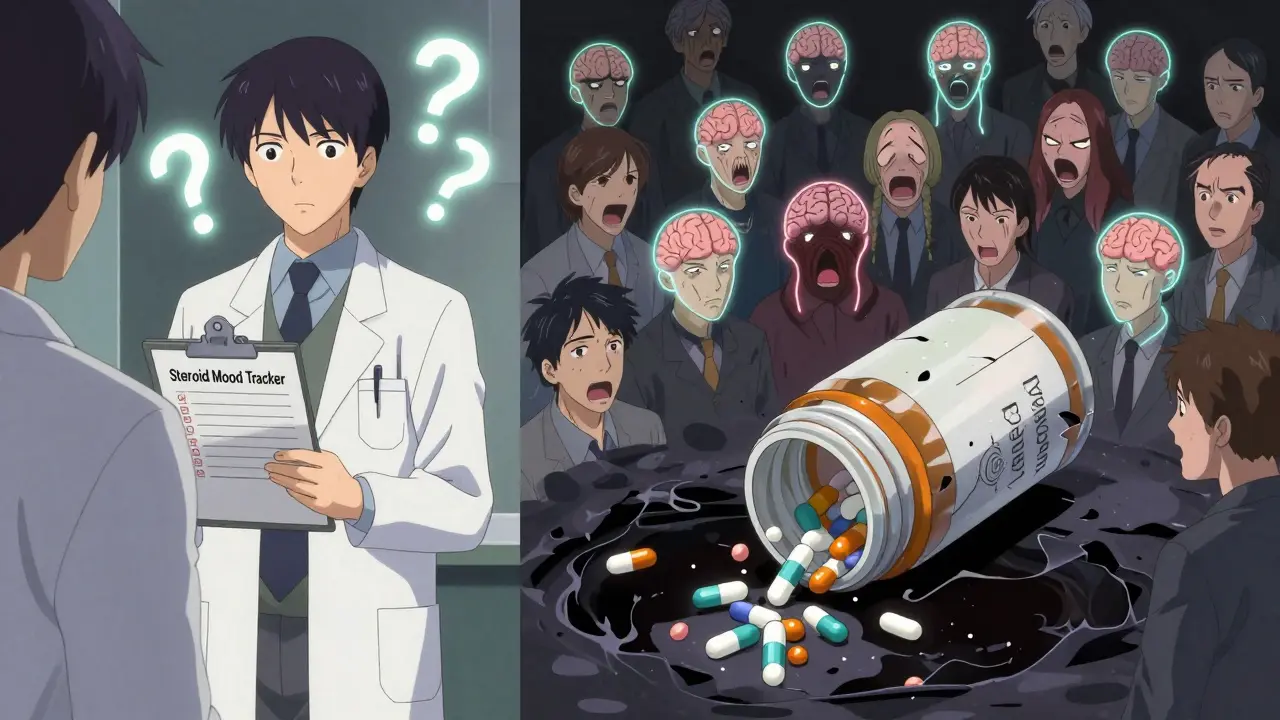
Researchers are calling for "clinimetric methods" - simple, reliable tools to measure mood changes early. Imagine a quick questionnaire your doctor could ask you on day three of treatment. Would you feel more energetic? More anxious? Have trouble sleeping? That could catch problems before they turn into psychosis.
Until then, awareness is your best defense. If you’re on these drugs, pay attention to your mind as much as your body. And if something feels wrong - trust that feeling. It might be your brain telling you something the medicine didn’t warn you about.
Kevin Y.
March 24, 2026 AT 06:12Thank you for writing this. As a clinician, I’ve seen too many patients dismissed as "just anxious" when they’re clearly experiencing steroid-induced psychosis. The disconnect between clinical awareness and patient education is staggering. We need standardized screening protocols-like a simple 3-question checklist on day 2 or 3 of treatment. It’s not complicated, and it could save lives.
Also, why is this still not on drug labels in bold? If we warn about weight gain and blood sugar, why not mood swings with the same urgency?
Raphael Schwartz
March 24, 2026 AT 17:54lol steroids make u crazy? shocker. next u’ll say water makes u wet.
Marissa Staples
March 26, 2026 AT 11:40I wonder if this is part of why so many people feel like they’ve lost themselves after long-term steroid use. Not just the mood swings, but the sense that your emotions aren’t yours anymore. Like someone else is living your skin. It’s not just chemistry-it’s identity erosion.
I’ve watched a friend go from gentle, thoughtful, to screaming at her dog for breathing too loud. And then, after stopping, she didn’t recognize herself for months. Like she had to relearn how to be human.
Rachele Tycksen
March 26, 2026 AT 12:39so like… steroids make u bipolar? cool. my aunt went thru that. forgot to tell her doc tho. oops.
Grace Kusta Nasralla
March 26, 2026 AT 13:57It’s funny how we treat the body like a machine, but the mind? Oh, that’s just "stress." We’ll fix your knee, but when your soul starts unraveling? We hand you a Xanax and tell you to breathe.
Maybe the real crisis isn’t the drug-it’s that we’ve forgotten people aren’t symptoms to be managed. They’re humans with histories, fears, and fragile neurochemistry.
And we’re still surprised when the system breaks.
Korn Deno
March 28, 2026 AT 12:56The brain doesn’t care about your prescription. It only cares about balance. Steroids don’t just suppress inflammation-they hijack the very systems that keep you grounded. Dopamine spikes. Hippocampus shrinks. HPA axis collapses. It’s not magic. It’s biology.
And yet we treat it like a personality flaw. That’s the real tragedy.
Aaron Sims
March 30, 2026 AT 11:54Ohhh so NOW the medical industry is "overlooking" psychiatric side effects? LOL. Who do you think wrote the drug labels? The same people who told us Vioxx was safe? Or that cigarettes were good for you? This isn’t negligence-it’s profit.
They don’t want you to know steroids can turn you into a paranoid lunatic. Because then you’d stop taking them. And then they’d stop making billions.
Also-have you heard about the secret studies they buried? The ones where 40% of patients had full-blown psychosis? Yeah. Me neither. Because they’re not on PubMed.
Stephen Alabi
March 31, 2026 AT 05:32While the data presented is statistically significant, it lacks contextual rigor. The 18% psychosis rate cited applies only to high-dose, short-term regimens in controlled clinical trials-yet the author generalizes to all users. This is a classic case of ecological fallacy.
Furthermore, attributing depression to steroids without controlling for pre-existing comorbidities, socioeconomic stressors, or illness-related trauma is methodologically unsound. The correlation is real, but causation requires longitudinal, double-blind, placebo-controlled studies-which, as of 2024, remain scarce.
Respectful skepticism is not denial. It is science.
Agbogla Bischof
April 1, 2026 AT 07:29As a pharmacist in Lagos, I’ve seen this firsthand. A 62-year-old woman on prednisone for lupus started believing her neighbors were poisoning her food. She stopped eating. Her family thought she was "crazy." We switched her to every-other-day dosing and added olanzapine. Within 72 hours, she was laughing again.
Doctors here don’t ask about mood. They check blood pressure, glucose, sodium. That’s it. We need training. We need awareness. This isn’t just an American problem-it’s global.
Pat Fur
April 2, 2026 AT 14:06My grandma took steroids for a flare-up. She became convinced the TV was talking to her. We thought she was having dementia. Turns out, it was the medicine. She got better after they lowered the dose-but she never trusted doctors again.
It’s not just about the science. It’s about trust. And if we keep ignoring this, we’ll lose more than patients-we’ll lose their faith.
Anil Arekar
April 2, 2026 AT 18:32This is an essential contribution to the discourse on iatrogenic harm. The medical model has long prioritized physiological outcomes over psychosocial ones, creating a blind spot that disproportionately affects vulnerable populations. We must integrate mental health assessments into standard steroid protocols-not as an afterthought, but as a core component of care.
Let us not forget that healing is not merely the absence of disease, but the restoration of wholeness.
Elaine Parra
April 3, 2026 AT 21:53Oh, so now we’re blaming drugs for people being "crazy"? What about the fact that 70% of people on steroids are already stressed out from being sick? Maybe they’re just emotionally unstable to begin with. This feels like medical gaslighting wrapped in a pretty infographic.
And why is this article so long? Did you run out of things to say? Just say it: steroids can mess with your head. We get it. Stop preaching.
Rama Rish
April 4, 2026 AT 12:25my friend took steroids for asthma and became super nice then suddenly yelled at her mom for 10 mins over a teapot. then she cried for 3 hrs. doc said "stress". it was the steroids.
Kevin Siewe
April 4, 2026 AT 20:28Thank you for sharing this. I’m a nurse, and I’ve seen too many patients dismissed because their symptoms don’t fit the physical profile we’re trained to monitor. This isn’t just about steroids-it’s about how we define care. If we’re not watching the mind, are we really healing?
I’ve started asking patients on steroids: "Have you felt like yourself lately?" Just that one question has opened up conversations I never knew were needed.