Medication Guide Distribution Checker
This tool helps determine if a Medication Guide must be distributed based on FDA requirements. Answer the questions below to check if you need to provide a Medication Guide for your specific situation.
Distribution Requirements Checker
Distribution Result
The Medication Guide is not required for this scenario.
Reason: Medication Guides are not required in inpatient hospital settings according to FDA regulations.
Always verify with the latest FDA guidance and drug-specific requirements. This tool provides general guidance based on the article content.
When you pick up a prescription, you might get a small folded paper along with your pills. That’s not just a flyer-it’s a Medication Guide, and in many cases, it’s the law. The FDA requires these guides for over 200 prescription drugs that carry serious risks. But not every drug needs one. Not every pharmacy distributes them the same way. And not every patient even gets one-depending on where and how the drug is given. If you’re a pharmacist, nurse, or provider, getting this wrong isn’t just a paperwork issue. It’s a patient safety issue.
What Exactly Is a Medication Guide?
A Medication Guide (MG) is an FDA-approved, drug-specific handout written in plain language for patients. It’s not the same as the technical package insert doctors read. It’s not a general info sheet from a drug company. It’s a legally required document designed to warn patients about serious side effects, explain when the drug is dangerous, and make sure they understand how to use it safely. These guides are mandatory for drugs that meet one of three FDA criteria:- The drug has serious side effects that could be prevented if patients know the risks
- The risks of the drug outweigh the benefits for some people, and patients need to make informed choices
- Patients must follow the dosing instructions exactly-or the drug won’t work
When Must You Distribute a Medication Guide?
This is where things get tricky. You don’t hand out a Medication Guide every time you dispense a drug. The FDA says you only need to do it in five specific situations:- When the patient or their caregiver asks for it. Even if it’s not required, if someone requests it, you give it.
- When the drug is dispensed for self-administration in an outpatient setting. Think: a patient walking out of a clinic with a new prescription for a high-risk drug. That’s when you hand them the guide.
- The first time a drug is dispensed to a provider for administration in an outpatient setting. If you’re an infusion center giving epoetin alfa weekly, you only need to give the guide once-unless the guide changes.
- When there’s a material change to the guide. If the FDA updates the content-say, adds a new warning-you must give the new version the next time the drug is dispensed.
- When the drug is part of a REMS program with specific guide requirements. For example, the iPLEDGE program for isotretinoin requires the guide to be reviewed and distributed before the patient can get the drug.
Pharmacists Are the Gatekeepers
In community pharmacies, the rule is simple: if a patient walks in to pick up a drug that requires a Medication Guide, you give them one. Every time. Even if they got it last month. That’s because the FDA considers each dispensing event separate. A refill isn’t just a refill-it’s a new opportunity to inform. But outpatient clinics? That’s where confusion sets in. A 2022 survey of 1,247 hospital pharmacists found that 68% weren’t sure when to hand out guides in infusion centers or dialysis units. Some gave them every visit. Others never did. Both were wrong. The key is this: one guide per patient, per drug, per first administration-unless the guide changes. So if a patient gets methotrexate every week for rheumatoid arthritis, you hand them the guide the first time. Next week? No need. Unless the FDA updated the guide. Then you give the new version.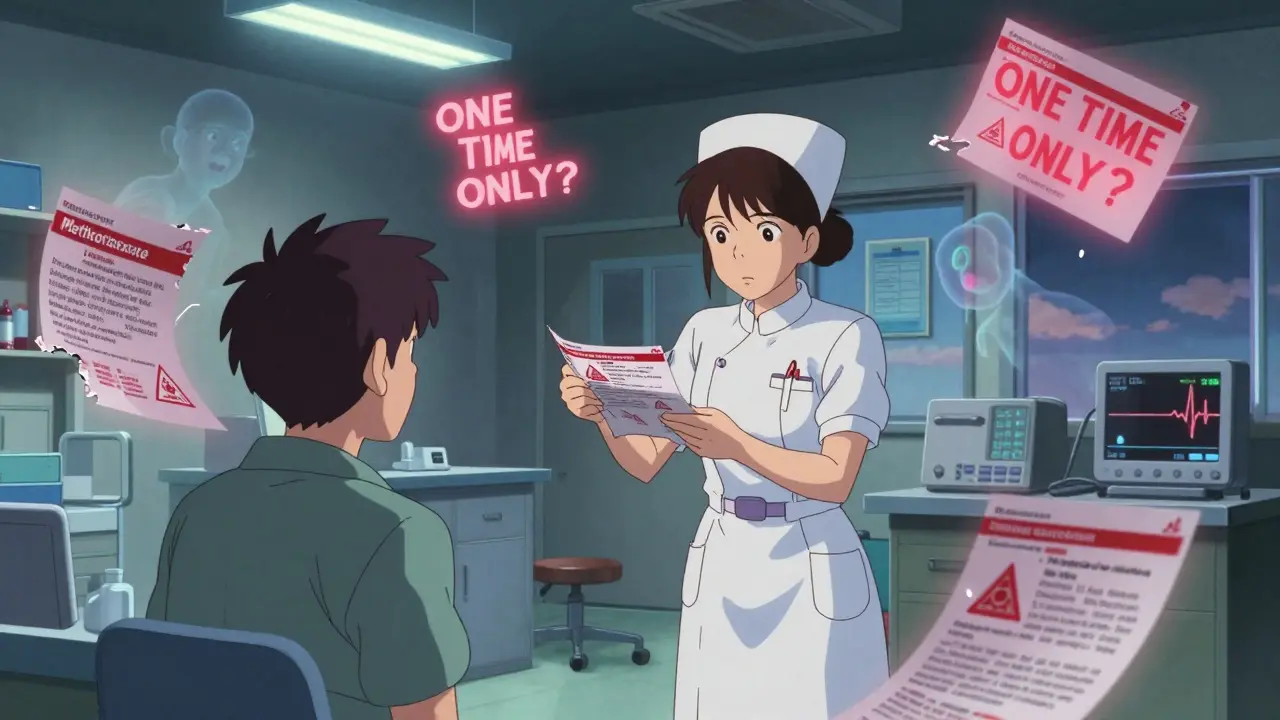
Electronic Delivery Is Now an Option
In March 2020, the FDA clarified that patients can request electronic copies instead of paper. That means you can email them a PDF, send a link via patient portal, or even text a secure link. But here’s the catch: you still have to offer the paper version. You can’t force someone to go digital. The FDA is now considering expanding electronic options even further. A proposed rule in May 2023 suggests allowing providers to send digital guides as the default-so long as paper is still available upon request. This could cut down on printing costs and reduce waste. But for older patients, those without smartphones, or those who just prefer paper, the printed guide remains mandatory.How Medication Guides Are Different
Don’t confuse them with other patient materials. There are three common types:- Medication Guides = FDA-approved, mandatory, drug-specific, plain language.
- Consumer Medication Information (CMI) = Voluntary, often generic, created by pharmacies or vendors. No FDA review.
- Package Inserts = For healthcare pros. Full of jargon, dense, not meant for patients.
What’s Going Wrong?
The system isn’t broken-but it’s messy. Pharmacists report:- Not knowing if a guide changed because they didn’t get the FDA alert
- Confusion between inpatient vs. outpatient rules
- Patients asking for guides they don’t need, and not knowing how to respond
What’s Next?
The FDA is reviewing the entire program. A congressionally mandated study is due in late 2024. Early signs suggest:- More drugs will need guides-especially in oncology and rare diseases
- Guides will be redesigned for better readability
- Electronic delivery may become standard, but paper stays as backup
What You Need to Do
If you’re a pharmacist or provider:- Know which drugs in your inventory require a guide. Keep a list.
- Train your team on the five distribution rules. Don’t assume.
- Set up alerts for guide updates. Subscribe to FDA notifications.
- Offer both paper and electronic options. Never force one.
- Don’t skip the guide just because the patient says, “I don’t need it.” You’re not the judge of their risk.
Do I have to give a Medication Guide every time a patient refills a prescription?
Yes, if the drug requires a Medication Guide and the patient is picking it up for self-administration. Each dispensing event is treated as a separate occurrence by the FDA. Even if the patient received the guide last month, you must provide it again unless the drug is administered by a provider in an outpatient setting (like an infusion center), in which case you only give it the first time.
Can I email the Medication Guide instead of printing it?
Yes, but only if the patient requests it or you offer it as an option. The FDA requires that paper copies be available upon request. You can’t make electronic delivery mandatory. Many pharmacies now use patient portals or secure email to send PDFs, but you must still be ready to print a copy if asked.
Are Medication Guides required in hospitals?
No. Medication Guides are not required in inpatient hospital or nursing home settings because patients are under direct supervision. However, healthcare staff must still verbally explain risks, side effects, and dosing instructions. The guide itself isn’t needed-but the conversation is.
What happens if I forget to give a Medication Guide?
There’s no automatic fine, but failure to comply can lead to regulatory scrutiny, especially if a patient suffers harm. The FDA expects providers to follow the rules. Inconsistent distribution may trigger audits or inspections, particularly for drugs with REMS programs. More importantly, you risk patient safety. If a patient doesn’t know about a serious side effect, they may not report it-and that can be deadly.
How do I know if a Medication Guide has been updated?
Subscribe to the FDA’s Drug Safety Communications and Medication Guide updates. Manufacturers are required to notify providers of changes, but many don’t. Check the FDA’s website directly for updated guides. Some pharmacy systems now integrate with FDA databases to auto-flag changes. If in doubt, assume the guide has changed and provide the latest version.
Do all high-risk drugs have Medication Guides?
No. Only about 15% of prescription drugs in the U.S. require them. The FDA only mandates guides for drugs that meet specific risk criteria. Many high-risk drugs-like blood thinners or insulin-don’t have guides because their risks are managed through other means (like monitoring, training, or professional labeling). The guide is reserved for situations where patient understanding is critical to safety.
Steven Pam
February 25, 2026 AT 13:15Just got back from my local pharmacy and they handed me the guide for my new Rx like it was a receipt. No big deal, right? But honestly? I read it. Like, actually read it. Turns out my ‘harmless’ acne med could mess with my liver if I don’t monitor it. Mind blown. 🤯
Pharmacists aren’t just pill dispensers anymore-they’re the last line of defense. We need to stop treating these guides like junk mail.
Gabrielle Conroy
February 26, 2026 AT 22:27YES!! I’m a nurse and I’ve seen patients skip the guide because ‘it’s too long’-then come back in panic because they didn’t know about the seizure risk with lamotrigine. 😭
PLEASE stop assuming patients will ‘just know.’ Not everyone Google’s side effects. Not everyone has a med student cousin. The guide is their lifeline. Print it. Email it. Hand it to them like it’s a baby’s first blanket. 🤲
And if you’re a provider: if the patient says ‘I don’t need it,’ say ‘I know, but the FDA says I have to give it.’ You’re not the judge. The FDA is. 💯
Larry Zerpa
February 28, 2026 AT 18:41Let’s be real-the FDA doesn’t care about patient safety. They care about liability. This whole system is a legal shield for drug companies. They don’t want to be sued, so they force pharmacists to hand out paper that 90% of patients never open.
And yet? No one ever gets fined. No one ever gets audited. It’s performative compliance. A theater. A distraction from the real issue: we need better drug education at the K-12 level, not more paper.
Also, ‘electronic delivery’? Great. Until your 72-year-old grandma doesn’t have a smartphone. Or Wi-Fi. Or the patience to click ‘accept terms’ five times. This isn’t innovation. It’s exclusion disguised as progress.
Michael FItzpatrick
March 1, 2026 AT 20:38Y’all are missing the forest for the trees. The Medication Guide isn’t about paperwork-it’s about dignity. It says: ‘You are not a number. You are not a risk factor. You are a person who deserves to understand what’s going into your body.’
I work in a rural clinic. We had a patient who refused the guide for her diabetes med. We didn’t push. We sat. We asked why. She said: ‘I’ve been told I’m too fat to take this. I don’t want more proof I’m broken.’
We didn’t hand her a guide. We handed her a conversation. We listened. We adjusted. And then? We gave her the guide. With a hug.
Rules are important. But humanity? That’s the real Rx.
Brandice Valentino
March 3, 2026 AT 03:09Ugh. Another one of those ‘FDA says’ rants. Like, wow. Groundbreaking. Did you know the FDA also says we should brush our teeth? Or that gravity exists? I mean, come on.
And ‘electronic delivery’? Please. I’m supposed to trust a PDF from some pharmacy portal? I’d rather have a sticky note from my cousin’s dog.
Also, who wrote this article? A marketing intern for a drug company? ‘It’s a lifeline written in plain language’-speak for yourself. I’ve read these things. They’re full of ‘may cause’ and ‘rarely associated with’ and ‘consult your provider.’
It’s not a guide. It’s a legal disclaimer with a font change.
Erin Pinheiro
March 3, 2026 AT 21:49OMG I JUST REALIZED I NEVER GOT A GUIDE FOR MY ANTI-DEPRESSANT AND NOW I’M SCARED I’M GONNA TURN INTO A ZOMBIE 😭
WHY DID NO ONE TELL ME?? I’VE BEEN TAKING THIS FOR 3 YEARS!!
IS THIS WHY I KEEP HAVING NIGHTMARES ABOUT FLYING CACTI??
WHO DO I SUE??
Maranda Najar
March 5, 2026 AT 09:05Let me just say this with the gravitas of a thousand white coats: The Medication Guide is not a suggestion. It is not a courtesy. It is not a bureaucratic afterthought. It is the sacred covenant between the patient’s autonomy and the state’s duty to protect life.
When a pharmacist withholds a guide-not because of oversight, but because of indifference-it is not merely a procedural lapse. It is an ethical fracture. A moral wound.
And for those who scoff-‘It’s just paper’-I ask: What is a death certificate? What is a will? What is a wedding vow? All paper. All sacred.
Do not underestimate the weight of ink on pulp. It holds the breath of the living.
Nandini Wagh
March 7, 2026 AT 00:32Oh honey. You think this is about safety? 😏
Let’s be real. The FDA doesn’t care if you live or die. They care if the drug company gets sued. That’s why the guide exists: to cover their backs.
And don’t even get me started on ‘electronic delivery.’ Next thing you know, they’ll be sending the guide via carrier pigeon. Or telepathy. Or maybe just whispering it into your ear while you sleep.
Meanwhile, my cousin’s kid got prescribed Adderall and the pharmacy gave him a pamphlet that said ‘may cause sudden death.’ No explanation. No follow-up. Just… here’s your death sentence. Have a nice day.
It’s not a guide. It’s a threat.
Lillian Knezek
March 7, 2026 AT 18:20EVERYTHING IS A LIE. 🕵️♀️
Did you know the FDA is owned by Big Pharma? They only require guides for drugs they want you to take. The real dangerous ones? The ones that make you forget your own name? They don’t give guides for those.
And the ‘electronic’ option? That’s how they track you. Every time you open the PDF, they log your IP. Your location. Your heartbeat. Maybe even your dreams.
They’re using the guides to build a neural map of the population. Next thing you know, your prescription will auto-refill… and your thoughts will be edited.
Print it. Keep it. Burn it. Don’t trust the system.