
Knowing when your medication expires isn’t just about following a label-it’s about safety, effectiveness, and avoiding hidden risks. Many people assume that if a pill still looks fine, it’s safe to take. But that’s not always true. Expiration dates aren’t arbitrary. They’re based on real science, and ignoring them can have real consequences.
What an Expiration Date Actually Means
An expiration date on a medicine bottle isn’t the day the drug turns toxic. It’s the last day the manufacturer guarantees the medication will work as intended and remain safe under proper storage conditions. This means it still has its full strength, purity, and effectiveness. After that date, the drug might start to break down. It doesn’t suddenly become poison, but it may not work as well-or worse, it could become unsafe.
The U.S. Food and Drug Administration (FDA) has required expiration dates on all prescription and over-the-counter drugs since 1979. These dates come from stability testing: manufacturers store samples under different conditions-heat, humidity, light-and track how long the medicine stays effective. Most drugs are tested for 1 to 5 years. Injections often last 2-5 years because they’re sealed and stable. Eye drops? Usually 6 months to 2 years because they’re prone to bacterial contamination once opened.
Common Expiration Date Formats You’ll See
Expiration dates aren’t always written the same way. You might see:
- Expiry: 08/23
- Exp date: 2025-12-31
- Use by: JAN 2024
- Expires: 31/12/2025
If you see just a month and year-like 08/23-it means the medication expires on the last day of that month. So 08/23 expires on August 31, 2023. If you see a full date like 2025-12-31, that’s straightforward: December 31, 2025.
Look for words like Expiry, Expires, Use by, or Exp. These all mean the same thing. If the label says Do not use after, that’s your pharmacy’s beyond-use date, not the manufacturer’s original expiration. That’s a big difference.
Manufacturer Date vs. Pharmacy Date: What’s the Difference?
When you get a prescription filled, the pharmacy puts its own label on the bottle. That label often says something like Discard after 1 year. That’s not the drug’s true expiration-it’s the pharmacy’s safety rule. Why? Because once a medicine is removed from its original sealed packaging and repackaged into a pill bottle, it’s more exposed to air, moisture, and temperature changes.
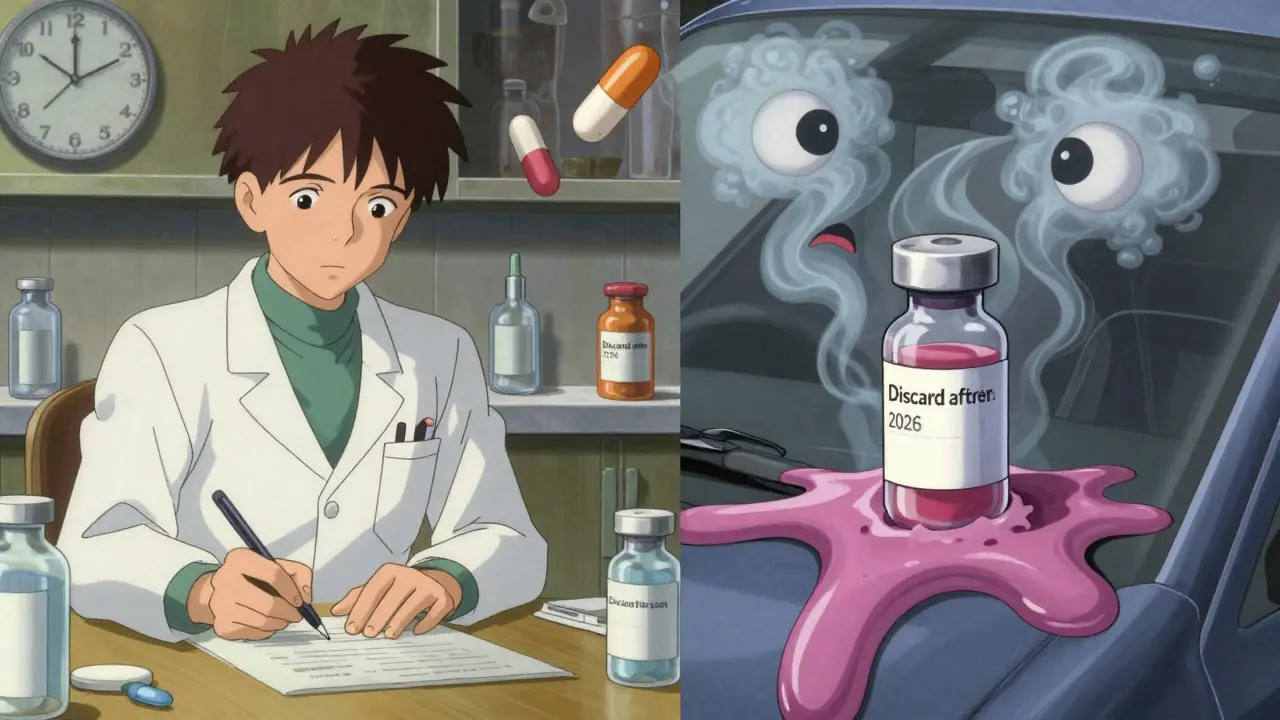
For example, your insulin might have a manufacturer expiration date of 2027. But the pharmacy puts a label on it saying Use by 2026. You should follow the pharmacy’s date. The same goes for liquid antibiotics. Many only last 14 days after being mixed with water, even if the original bottle says 2 years.
Here’s a tip: Ask the pharmacist to write the manufacturer’s expiration date on the bottle too. That way, you know both dates. If the pharmacy label says Discard after 6 months but the original box says 2027, you still go by the 6-month date.
When Expired Medication Can Be Dangerous
Most medications are safe past their expiration date. In fact, the FDA’s Shelf Life Extension Program found that 90% of drugs tested still worked 15 to 66 months beyond their labeled date-when stored perfectly. But that doesn’t mean you should take anything old.
Some medicines are too risky to use past their expiration:
- Insulin: Loses potency quickly. Taking weak insulin can mean uncontrolled blood sugar-dangerous for diabetics.
- Birth control pills: Even a small drop in hormone levels can lead to unintended pregnancy.
- Thyroid medication: If the dose is off, it can throw off your metabolism, heart rate, or mood.
- Antibiotics: Expired antibiotics might not kill all the bacteria. That leaves behind stronger, resistant strains.
- Antiplatelet drugs (like aspirin for heart protection): If they’ve degraded, they won’t prevent clots.
There’s one famous myth: tetracycline. Decades ago, some forms of this antibiotic were linked to kidney damage after expiring. But modern versions don’t have that problem. Still, never take tetracycline past its date.
How Storage Affects Expiration
Expiration dates assume you’ve stored the medicine correctly. If you keep your pills in a humid bathroom or on a windowsill where sunlight hits, they degrade faster.
Most medicines should be kept at room temperature (15-25°C), away from moisture and light. Some, like insulin or certain eye drops, need refrigeration. If your medicine says Refrigerate and you left it on the counter for a week, it might be ruined-even if the date hasn’t passed.
Heat is the biggest enemy. Leaving a bottle in a hot car, or storing it near a radiator, can break down active ingredients. Moisture turns pills into mush and invites mold. If your medicine looks discolored, smells weird, or has changed texture-don’t take it. Even if the date is still good.
What to Do When You Find an Expired Medicine
Don’t flush it down the toilet or toss it in the trash. That’s bad for the environment and risky for kids or pets. Instead:
- Check if your pharmacy or local government has a drug take-back program. Many do.
- If no program exists, mix pills with coffee grounds or cat litter in a sealed bag before throwing them away. This makes them unappealing and harder to misuse.
- For liquids, pour them down the sink with running water-only if no take-back option exists.
Keep the original packaging. It has the lot number, which helps if there’s a recall. Also, look for the DIN (Drug Identification Number) or GP (General Product) number-these confirm the product is approved by health regulators.
Smart Tips for Keeping Track
Here’s what works in real life:
- Mark your calendar: Set a reminder 3 months before expiration for critical meds like insulin or blood pressure pills.
- Use apps like MedSafe or MyTherapy to track multiple medications and get alerts.
- Keep original boxes. They’re your best reference for the true expiration date.
- When you refill a prescription, ask the pharmacist: Is this the same manufacturer? Is the expiration date the same?
- Check your medicine every 6 months. Look for changes in color, smell, or texture.
A 2022 study found that 68% of older adults thought an expired pill was immediately dangerous. It’s not. But it might not work. And that’s just as risky.
What’s Changing in the Future
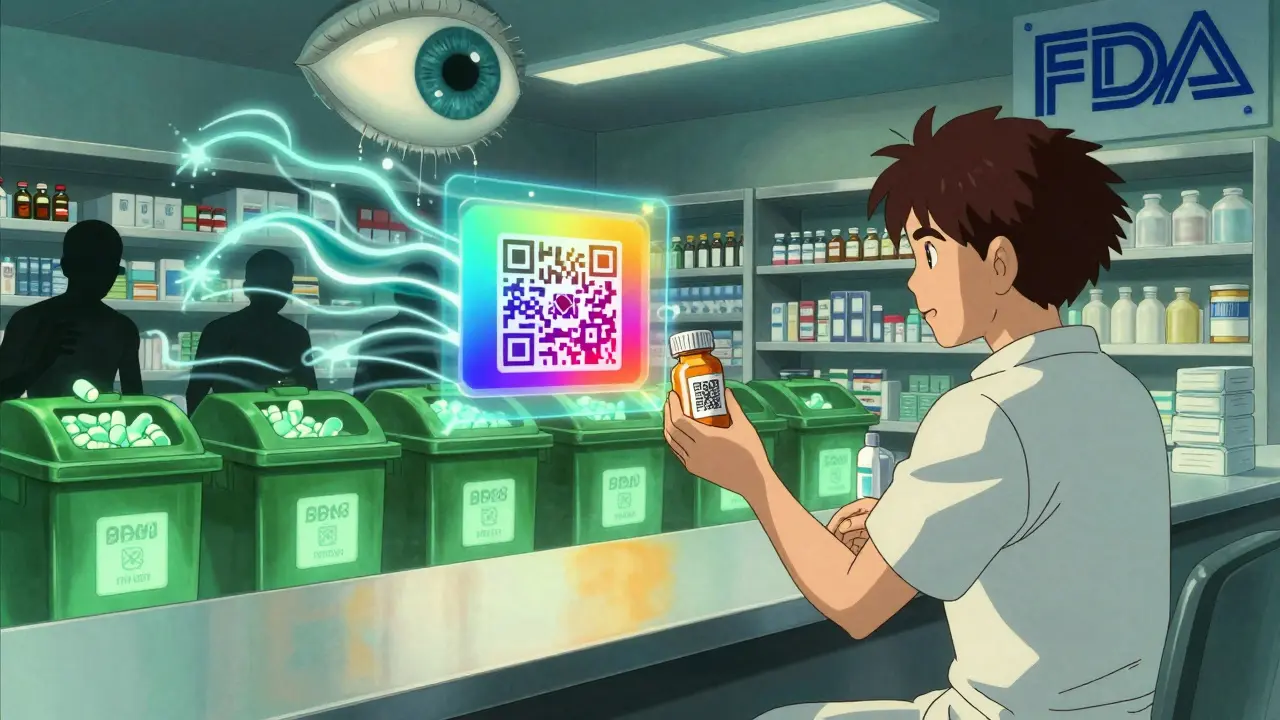
Drug labels are getting smarter. Some companies now use QR codes on packaging. Scan it, and you’ll see real-time storage info and expiration data. In Europe, new labels use thermochromic ink that changes color if the medicine got too hot. Merck started using this for insulin in late 2022.
The World Health Organization now recommends all countries use the YYYY-MM-DD format. That’s clearer than month/day/year or day/month/year. More countries are adopting it. But for now, you still need to know how to read the format on your bottle.
Despite these improvements, 42% of medication errors in 2022 were linked to expired drugs. That’s a lot. Most of them happened because people didn’t understand the labels.
Final Rule: When in Doubt, Ask
Your pharmacist is your best resource. They see expired meds every day. They know which drugs are safe past their date and which aren’t. If you’re unsure about a pill, call them. Don’t guess. Don’t risk it.
Medications aren’t like milk. They don’t go bad overnight. But they don’t last forever either. Reading the label correctly, storing them right, and knowing when to replace them isn’t just smart-it’s essential for your health.
Can I still take medicine after the expiration date?
Many medications remain safe and effective for months or even years past their expiration date if stored properly. The FDA found that 90% of tested drugs still worked well beyond their labeled date. But this doesn’t apply to all medicines. Insulin, birth control, thyroid pills, antibiotics, and antiplatelet drugs should never be taken past their expiration because they can become ineffective or dangerous.
What does 08/23 mean on a medicine label?
It means the medication expires on August 31, 2023. When only a month and year are listed, the expiration is the last day of that month. So 08/23 = August 31, 2023. Always assume the last day of the month unless a full date is given.
Should I follow the pharmacy’s expiration date or the manufacturer’s?
Always follow the pharmacy’s label if it says "Discard after" or "Do not use after." That date is set based on how the medication was repackaged and stored after leaving the manufacturer. For example, if your insulin bottle says "Use by 2026" but the original box says 2027, trust the 2026 date. The pharmacy’s date is more accurate for the medicine you’re holding.
How do I know if my medicine has gone bad?
Look for changes in color, texture, smell, or shape. Pills that are crumbly, discolored, or have a strange odor shouldn’t be taken. Liquids that are cloudy, have particles, or smell off are also unsafe. Even if the date is still good, these signs mean the medicine has degraded. Never take medication that looks or smells wrong.
Can I store medicine in the bathroom?
No. Bathrooms are too humid and warm, which can break down medicine faster. Store pills in a cool, dry place away from sunlight-like a bedroom drawer or kitchen cabinet. If the label says "Refrigerate," keep it in the fridge, not on the counter. Always follow the storage instructions on the box.
What should I do with expired medicine?
Don’t flush it or throw it in the trash without mixing it first. Use a drug take-back program if available. If not, mix pills with coffee grounds or cat litter in a sealed bag before disposal. For liquids, pour them down the sink with running water if no take-back option exists. Always keep the original packaging-it has the lot number and DIN, which may be needed for recalls.
Alexander Erb
March 11, 2026 AT 20:46Yo, this is actually super helpful 🙌 I just tossed out my old blood pressure meds last week because I thought they were useless after the date. Turns out, they were probably fine? Mind blown. Thanks for the clarity on storage too-my bathroom shelf is officially banned from meds now. 😅
Adam Kleinberg
March 13, 2026 AT 13:59Let me guess-the FDA says 90% of drugs are still good past expiration but you’re still supposed to throw them out? Classic. They’re protecting Big Pharma’s bottom line, not your health. I’ve been taking my antibiotics 3 years past date and my immune system’s never been stronger. They don’t want you to know you can save $500 a year by not replacing every bottle. The real danger? Trusting corporations over your own experience.
Shourya Tanay
March 13, 2026 AT 16:29Thank you for the granular breakdown of stability testing protocols and formulation degradation kinetics. The distinction between manufacturer-determined shelf life and pharmacy-derived beyond-use dates is particularly salient from a pharmacovigilance standpoint. I’m especially intrigued by the thermochromic ink developments-this aligns with emerging ISO 11607-2 standards for pharmaceutical packaging integrity monitoring. The QR code integration is a step toward real-time stability telemetry, which could revolutionize decentralized distribution models.
Tom Bolt
March 14, 2026 AT 17:53You wrote ‘don’t flush it down the toilet’-but you didn’t use a comma before ‘or toss it in the trash.’ That’s not just sloppy, it’s dangerous. Grammar is the scaffolding of public safety. If you can’t punctuate a sentence about medicine, how can we trust you on expiration dates? Also, ‘use by’ and ‘expires’ are not interchangeable in regulatory language. You’re doing harm by being lazy.
LiV Beau
March 16, 2026 AT 03:08OMG this is so timely!! I just found my grandma’s old thyroid pills in her drawer and was about to toss them… now I’m gonna call her pharmacist first 😊 I love how you made it feel doable instead of scary. Also, the app recs are gold-I’m downloading MyTherapy right now 📲💕
Denise Jordan
March 18, 2026 AT 01:39So… you’re saying I don’t have to panic every time my Advil is a few months past the date? Lmao I’ve been hoarding expired pills since 2018. This article just gave me permission to chill. Also, who even has time to check every bottle? 🤷♀️
Gene Forte
March 18, 2026 AT 01:42Every life is precious. Every pill matters. When we take the time to understand what we’re putting into our bodies, we honor the science, the caregivers, and ourselves. A simple label holds more wisdom than we often give it credit for. Let’s not treat health like a guessing game. Be intentional. Be informed. Be safe.
Kenneth Zieden-Weber
March 18, 2026 AT 14:37Wow, you actually wrote a whole thing about expiration dates without saying ‘consult your doctor.’ That’s practically a revolution. I’m impressed. Next time, maybe explain why we still use 1970s-style labeling in a world with smartphones? Just saying.