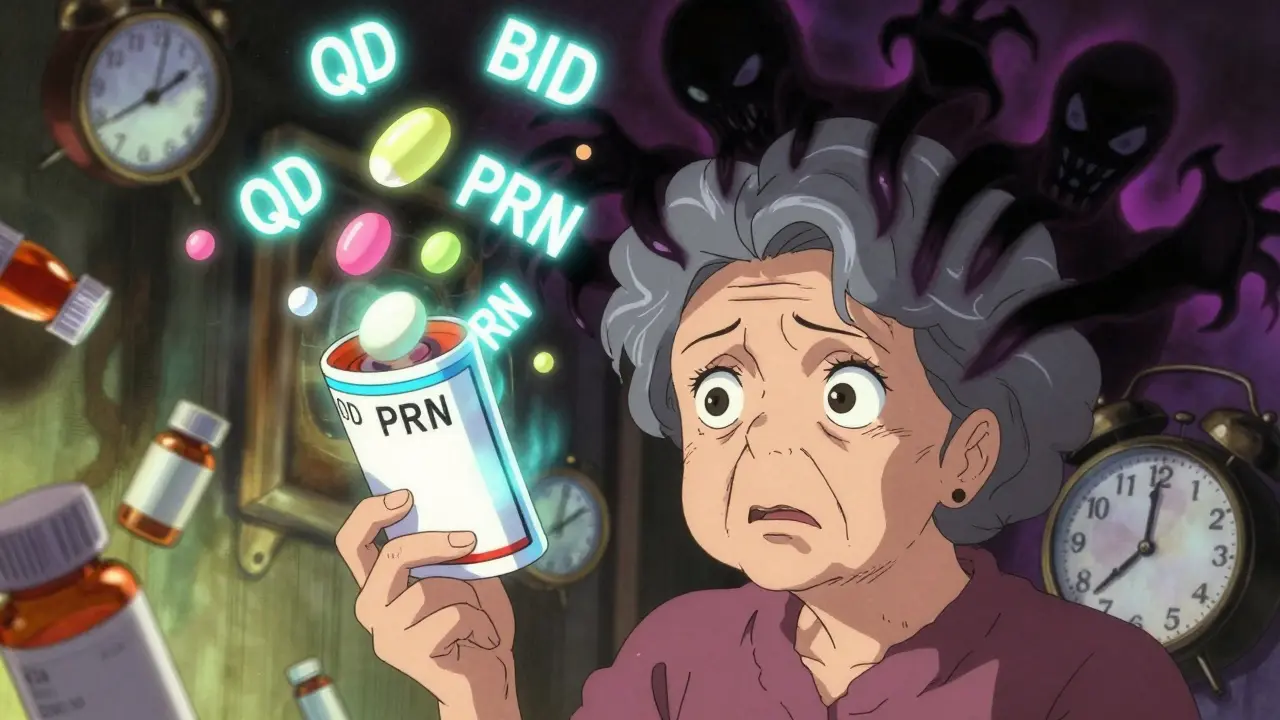
Ever stared at your prescription label and thought, Wait, what does this actually mean? You’re not alone. Millions of people in Australia and around the world are given medication instructions that are vague, inconsistent, or just plain confusing. A simple abbreviation like "q.d." or "BID" can mean nothing to you - but it could mean the difference between getting better and ending up in the hospital.
Why Medication Instructions Are So Hard to Understand
Medication labels often use shorthand that makes sense to doctors and pharmacists - but not to patients. Terms like "PO," "QID," or "PRN" aren’t everyday language. Even simple phrases like "take as needed" leave too much room for guesswork. Is "as needed" once a day? Three times? Only when the pain hits 7 out of 10? You don’t know - and that’s dangerous. The Institute for Safe Medication Practices (ISMP) says unclear instructions are behind about 1.5 million medication errors every year in the U.S. alone. These aren’t minor mistakes. They lead to hospital visits, organ damage, and even death. The FDA requires detailed Medication Guides for high-risk drugs like opioids, isotretinoin, and birth control pills - but those guides don’t cover most common medications. That leaves you stuck trying to decode instructions that were never meant to be decoded by someone without medical training.What You Should Do When Instructions Don’t Make Sense
The first rule? Never assume. If you’re unsure, ask. Don’t wait until you’ve taken the wrong dose. Don’t try to figure it out by comparing pills from different bottles. Don’t rely on memory. Go back to the source. Here’s exactly what to do:- Write down your question. Don’t just say, "I don’t get this." Be specific: "The label says "take one tablet by mouth twice daily," but the doctor said "in the morning and at bedtime." Are those the same?"
- Call your pharmacist. Pharmacists are trained to explain medication use. They see hundreds of prescriptions a day and know which ones are commonly misunderstood. Ask: "Can you walk me through how to take this?"
- Ask your doctor or nurse. If the pharmacist isn’t sure, or if the instruction seems to conflict with what your doctor said, call the clinic. Say: "I’m confused about how to take [medication name]. Can we clarify the timing and purpose?"
- Check the bottle and the prescription. Sometimes the pharmacy labels a generic version differently than the brand. Compare the name, dose, and instructions on the bottle with the original prescription slip. If they don’t match, that’s a red flag.
Common Abbreviations That Can Kill (And What to Say Instead)
Some abbreviations are so dangerous they’re banned in many hospitals. Here’s what you might see - and what it really means:- "q.d." or "QD" → Means "daily" - but looks like "q.i.d." (four times a day). Always write out "daily."
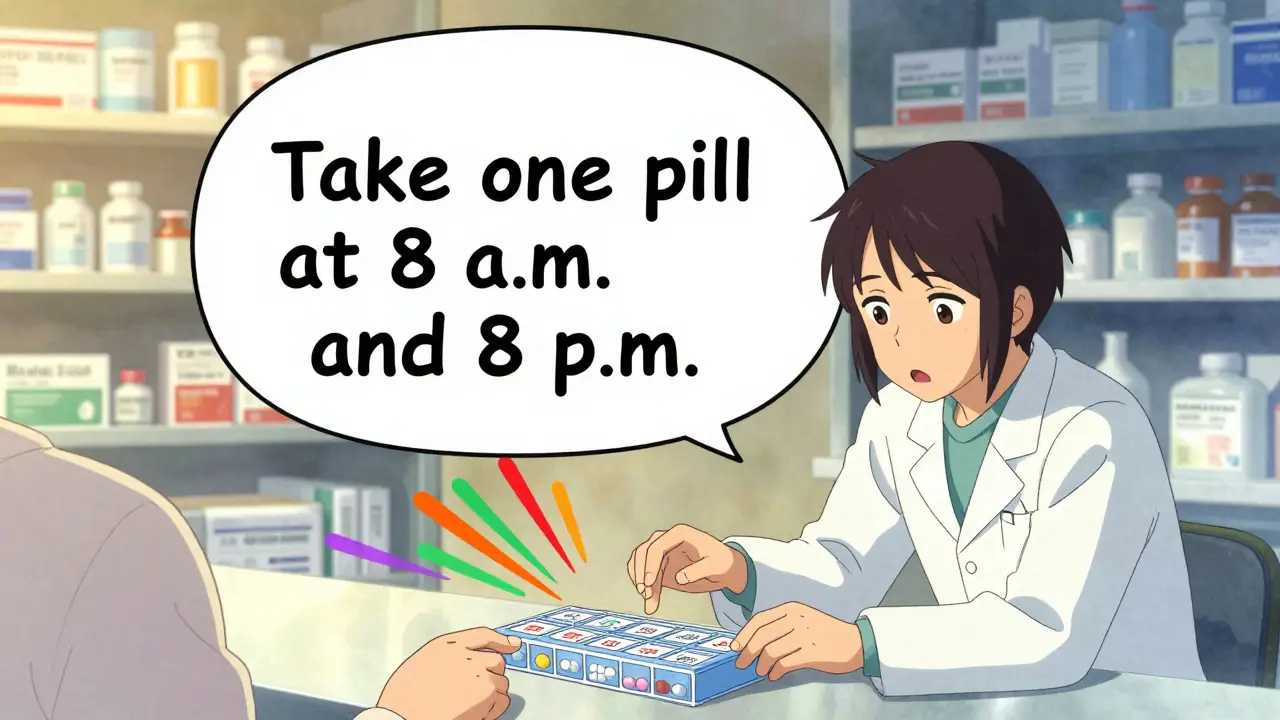
- "BID" → Means "twice a day." But without context, you won’t know if it’s morning and night, or breakfast and dinner. Ask: "Should I take it at 8 a.m. and 8 p.m.?"
- "PRN" → Means "as needed." But needed for what? Pain? Anxiety? Sleep? Ask: "What symptoms should I wait for before taking this? And what’s the max I can take in 24 hours?"
- "IN" → Could mean intranasal (into the nose) - but looks like IV (intravenous). Always say "into the nose" or "nasal spray."
- "d" in "mg/kg/d" → Could mean "day" or "dose." Ask: "Is this dose per day or per dose?"
Don’t be embarrassed to ask for plain language. You’re not being difficult - you’re being smart.
Timing Matters More Than You Think
When you take a medication isn’t just about convenience - it’s about effectiveness. Take cholesterol meds like statins at night, because your liver makes most cholesterol while you sleep. Take blood pressure pills in the morning to control spikes during the day. Take antibiotics at evenly spaced intervals - not just "with meals" - to keep drug levels steady. The CDC says timing errors are one of the top reasons people miss doses or overdose. If your instruction says "twice daily," aim for 12 hours apart: 8 a.m. and 8 p.m. If it says "every 6 hours," that’s four times a day - not just when you remember.Set phone alarms. Use pill organizers with labels. Write a note on your fridge. Don’t rely on your memory. If you’re on three or more medications - which nearly 1 in 4 adults are - you need systems, not hope.
What to Do When Two Pills for the Same Drug Have Different Instructions
This happens more than you’d think. Two different brands of the same generic drug - say, metformin - might have slightly different dosing instructions. One says "take with food," another says "take on an empty stomach." One says "once daily," another says "twice daily." The National Institutes of Health (NIH) says this isn’t just a paperwork issue - it’s a safety risk. If you switch brands and don’t notice the change, you might underdose or overdose. Here’s what to do:- When you pick up a refill, compare the new bottle to the old one.
- If instructions changed, call your pharmacist immediately.
- Ask: "Is this the same drug? Why are the instructions different?"
- Don’t assume the pharmacist changed it - sometimes the manufacturer did.
Pharmacists are required to check for these differences - but they won’t catch them if you don’t point them out. Be your own advocate.
How to Talk to Your Pharmacist Without Feeling Awkward
You don’t need to be a medical expert to ask good questions. Here are simple phrases that work:- "Can you explain how to take this in plain English?"
- "What happens if I take this at the wrong time?"
- "Is it safe to take this with my other meds?"
- "What side effects should I watch for?"
- "What if I miss a dose?"
Pharmacists hear these questions every day. They’re trained to answer them. If they seem rushed, say: "I want to make sure I get this right - can we take two minutes?" Most will stop and help.
What Happens If You Don’t Clarify?
Ignoring unclear instructions isn’t harmless. A 2023 Harvard Health study found that patients who didn’t ask questions about their meds were three times more likely to have a bad reaction. One man took his blood thinner at night instead of morning - and ended up in the ER with internal bleeding. A woman thought "PRN" meant "take when I feel anxious," so she took six doses in one day - and ended up in a coma. These aren’t rare cases. They’re preventable.Your Action Plan: 5 Steps to Take Control
1. Write it down. Keep a list of every medication you take - name, dose, timing, reason. Update it every time something changes. 2. Ask one question every time you get a new prescription. Even if you’ve taken it before. Things change. 3. Compare bottles. When you refill, check the label against the last one. If it’s different, call. 4. Use reminders. Set alarms. Use apps. Put pills in a box with days labeled. 5. Speak up. If something doesn’t make sense - say so. You’re not being difficult. You’re protecting your life.Medication safety isn’t just about what’s written on the bottle. It’s about what you understand. And understanding starts with asking.
Abby Polhill
December 23, 2025 AT 23:39Okay but let’s be real - the whole system is designed to make you feel dumb for asking. I’ve had pharmacists sigh when I asked what 'BID' meant. Like, it’s not my fault your industry still uses Latin abbreviations from 1923. I once took my anticoagulant at night because the label said 'once daily' and the doctor said 'morning.' Ended up in the ER. Now I write everything down in crayon on my fridge. 🖍️
Raja P
December 25, 2025 AT 12:01Bro, I’m from India and we don’t even get proper labels half the time. Sometimes the bottle just says 'take one' with no time or reason. I call my cousin who’s a nurse in Bangalore. She’s the real MVP. Just ask. No shame. Everyone’s confused. Even the doctors are rushing.
Joseph Manuel
December 26, 2025 AT 02:45The notion that patients should be responsible for decoding pharmaceutical shorthand is a systemic failure of healthcare communication infrastructure. The burden of cognitive load placed upon laypersons for interpreting ambiguous medical nomenclature is not merely inconvenient - it constitutes a violation of informed consent principles as defined by the Belmont Report. This is not a behavioral issue; it is a regulatory one.
Harsh Khandelwal
December 27, 2025 AT 12:22They don’t want you to understand. It’s all a racket. Big Pharma wants you confused so you keep coming back. That 'PRN' thing? That’s code for 'take it when you’re not watching.' I swear they put weird symbols on pills so the aliens can track us. Also, why do all the instructions say 'take with food' but never say WHAT food? Is toast enough? Do I need a full Thanksgiving dinner? 😭
Andy Grace
December 29, 2025 AT 06:44I’ve been on meds for years and still double-check every refill. I don’t say anything unless I’m sure - but if something’s off, I’ll sit in the pharmacy parking lot for ten minutes before driving off. It’s not about being loud. It’s about not dying quietly.
Delilah Rose
December 30, 2025 AT 17:52So I just want to say that I think this whole thing is really important because I used to be the person who just took whatever was on the bottle without thinking, and then I had this one time where I took my blood pressure med at the same time as my thyroid med and I think they canceled each other out or something and I ended up feeling like I was floating through a fog for three days and I didn’t even realize it was the meds until my sister pointed out that I was talking to the toaster and I thought it was my cat, and I just want to encourage everyone to not be like me because I was so embarrassed and also kind of terrified and now I have a whole color-coded spreadsheet with emojis and everything and I even set up a Google calendar reminder with a little bell sound and I know it sounds excessive but I’d rather be excessive than dead, you know? And also my pharmacist gave me a sticker that says 'I ASKED' and I put it on my water bottle so I see it every morning and it makes me feel like a superhero even though I’m just a person who forgot to eat breakfast again.
Spencer Garcia
December 31, 2025 AT 16:54Write it down. Set alarms. Call the pharmacist. Done. No drama needed.
Lindsey Kidd
January 1, 2026 AT 03:59YESSSS this!! 🙌 I keep a little notebook in my purse with all my meds, times, and why I’m taking them. My pharmacist knows me by name now and gives me extra gummy vitamins. 🍬 I used to be too shy to ask - now I say, 'Hey, can you translate this from Pharma-ese?' and they laugh and do it. You’re not annoying - you’re saving your life. 💪❤️
Austin LeBlanc
January 2, 2026 AT 03:48Wow, you people are pathetic. If you can’t read a simple label, maybe you shouldn’t be on meds at all. I’ve been on 12 prescriptions since I was 18 and I never needed to ask anyone anything. You just look at the pill, count the dots, and figure it out. Stop being lazy and take responsibility. This post is just enabling incompetence.
niharika hardikar
January 3, 2026 AT 02:15It is imperative to recognize that the proliferation of non-standardized pharmaceutical nomenclature constitutes a gross dereliction of duty on the part of regulatory bodies and healthcare institutions. The absence of mandatory patient-facing plain-language labeling violates the ethical tenets of beneficence and non-maleficence as codified in the Hippocratic Oath. Furthermore, the normalization of patient self-advocacy as a remedial strategy rather than a systemic imperative reflects a profound epistemological failure in medical education and public health policy.