
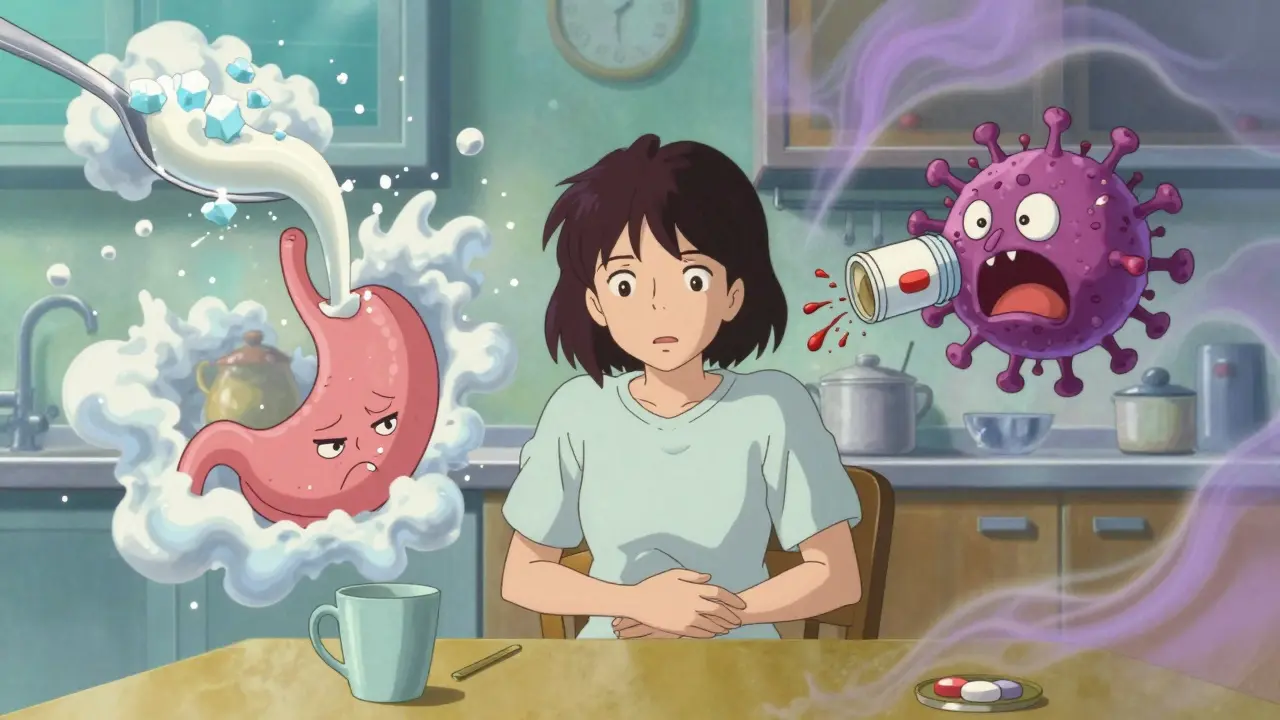
Knowing whether your reaction is from food or medicine can mean the difference between avoiding a harmless meal and missing a life-saving drug. Both food and medication allergies trigger the immune system, but they’re not the same. Confusing them can lead to unnecessary restrictions, dangerous mistakes, or even missed diagnoses. If you’ve ever been told you’re allergic to penicillin after a rash, or blamed your stomach upset on dairy when it was actually a new pill - you’re not alone. Let’s break down how to tell them apart, for real.
How Your Body Reacts: IgE vs. Other Pathways
Most food allergies are IgE-mediated. That means your body makes a specific antibody called immunoglobulin E that reacts immediately when you eat the trigger food. In 90% of acute food allergy cases, symptoms show up within minutes - often under 20 minutes. Think itching in the mouth, hives, swelling, vomiting, or trouble breathing. This is the classic anaphylaxis pattern.
Medication allergies are more complex. About 80% of immediate reactions are IgE-mediated too - like hives or anaphylaxis after penicillin. But 20% are delayed, driven by T-cells, not IgE. These can take days or even weeks to show up. A rash from amoxicillin might appear 7 to 14 days after you start taking it. That’s not a food allergy timeline. It’s a red flag for a drug reaction.
Symptoms: Where It Hurts
Food allergies often start in the mouth. About 70% of people feel itching or swelling of the lips, tongue, or throat right after eating. That’s called oral allergy syndrome. Then come the GI symptoms: vomiting in over half of kids, diarrhea in a third. Hives show up in nearly 9 out of 10 reactions.
Medication allergies? Skin reactions are common - a flat, red rash (maculopapular) in 95% of delayed cases. Hives happen too, but they’re less consistent. What sets drugs apart is how often they cause systemic issues: fever, swollen lymph nodes, or organ inflammation. Serum sickness can make you feel flu-like with joint pain. DRESS syndrome can damage your liver or kidneys. These aren’t typical food allergy signs.
Timing: The Biggest Clue
Timing is everything. If you ate shrimp at 7 p.m. and broke out in hives by 7:15 p.m.? That’s food. If you took a new antibiotic on Monday and didn’t get a rash until Friday? That’s likely a drug reaction.
Ninety-five percent of food allergy reactions happen within two hours. The median? Just 20 minutes. For medications, it’s split. About 85% of immediate reactions happen within an hour. But 70% of non-IgE reactions appear 48 to 72 hours later - sometimes even longer. That delay is a hallmark of drug allergies, not food.
Diagnosis: What Doctors Actually Do
For food allergies, skin prick tests are the go-to. They’re 90% accurate for IgE-mediated allergies. Blood tests measure IgE levels. But the real gold standard? The oral food challenge. You eat tiny amounts of the suspected food under medical supervision. If you react - bingo. If not, you’re probably not allergic. About 80% of kids outgrow milk or egg allergies by age 5, and testing confirms it.
Medication testing is trickier. Penicillin skin testing is highly reliable - 99% negative predictive value. If you test negative, you’re almost certainly not allergic. But for other drugs? There’s no easy test. Lymphocyte transformation tests or drug provocation challenges (giving you the drug again in tiny, controlled doses) are sometimes needed. Many doctors avoid these because they’re risky. That’s why so many people are wrongly labeled allergic.
The Big Misconception: Self-Reported Allergies Are Often Wrong
Here’s the scary part: up to 90% of people who say they’re allergic to penicillin aren’t. They had a rash as a kid, got told “you’re allergic,” and never got tested. Same with food. A 2023 study found that 22% of people who thought they had a food allergy were actually dealing with something else - like acid reflux or lactose intolerance.
One case involved a woman who avoided all NSAIDs for 10 years because she thought she was allergic to aspirin. Turns out, it was the lactose in the pill filler that gave her stomach cramps. No real allergy. Just a bad label.
And here’s the cost: people labeled penicillin-allergic are often given broader-spectrum antibiotics. Those are 30% more expensive and linked to 25% higher rates of C. diff infections. That’s not just a medical error - it’s a public health issue.

What You Can Do
If you think you have an allergy, start a journal. For food: write down exactly what you ate, how it was cooked, and when symptoms started - down to the minute. For meds: note the drug name, dose, time taken, and when symptoms appeared. Did it happen every time? Or just once?
Don’t assume. If you were told you’re allergic to a common drug like penicillin, ask for testing. It’s safe, quick, and can change your life. If you’ve had a reaction to food, see an allergist. Don’t self-diagnose with elimination diets alone - they can miss serious allergies.
And if you’re a parent? Kids outgrow food allergies all the time. Don’t keep them off milk or eggs forever just because they had a rash at age 2. Get them tested.
Why It Matters
Misdiagnosing a food allergy as a drug allergy - or vice versa - can cost lives. People with true food allergies die each year because they didn’t recognize anaphylaxis early enough. Others die because they were denied the only antibiotic that could save them.
Accurate diagnosis means you can eat safely, take necessary meds, and avoid unnecessary restrictions. It’s not about being cautious - it’s about being precise.
Can a food allergy develop in adulthood?
Yes. While most food allergies start in childhood, shellfish, tree nuts, and peanuts can appear for the first time in adults. About 4% of adults develop new food allergies after age 18. This is different from medication allergies, which can develop at any age but are more common in middle age, with a median onset around 42.
If I had a rash after taking amoxicillin, does that mean I’m allergic?
Not necessarily. Many rashes from amoxicillin happen during viral infections like mononucleosis or the flu - the virus, not the drug, is the real trigger. Studies show up to 90% of people labeled as penicillin-allergic after a rash have no true allergy. Testing can confirm whether you’re truly allergic or just got unlucky timing.
Can medication allergies be outgrown like food allergies?
Sometimes. About 80% of people who had a penicillin allergy in childhood lose their sensitivity after 10 years without exposure. But unlike food allergies, there’s no predictable pattern. You can’t assume you’ve outgrown it. Only testing can tell you for sure.
Is a stomach ache after eating dairy always a food allergy?
No. Most people who get bloated or have diarrhea after dairy have lactose intolerance - not an allergy. Food allergies involve the immune system and can cause hives, swelling, or breathing trouble. Lactose intolerance is a digestive issue. Testing can tell the difference.
What should I do if I’m unsure whether it’s food or medication?
See an allergist. Bring your symptom journal. Avoid self-diagnosis. Don’t stop taking meds or cutting out foods without testing. An allergist can use skin tests, blood tests, or supervised challenges to find the real cause - and prevent future mistakes.
Janelle Pearl
March 9, 2026 AT 10:23I’ve seen so many people self-diagnose food allergies after one bad reaction - and then they cut out entire food groups for years. I’m an allergist’s assistant, and I can tell you, most of them weren’t allergic at all. Just lactose intolerant, or had a viral rash, or reacted to a filler. It breaks my heart to see someone avoid cheese because they got sick once at 12.
Get tested. It’s not scary. It’s liberating.
Neeti Rustagi
March 11, 2026 AT 04:01While the article presents a clinically sound framework for distinguishing between food and medication allergies, it is imperative to acknowledge the systemic underfunding of allergy diagnostics in primary care settings. In many developing nations, including India, skin prick tests and oral challenges remain inaccessible due to infrastructural and economic barriers.
Furthermore, the reliance on IgE testing as a gold standard overlooks non-IgE mediated pathways that are increasingly documented in adult-onset food sensitivities. A purely immunological model may not suffice in populations with high rates of parasitic infections, which modulate IgE responses.
Policy reform must precede public education.
Morgan Dodgen
March 11, 2026 AT 10:21Let’s be real - Big Pharma doesn’t want you to know that 90% of penicillin ‘allergies’ are false. Why? Because they profit off of those expensive broad-spectrum antibiotics.
And don’t get me started on the FDA - they approved drug trials with placebo groups that didn’t even test for T-cell mediated reactions. Meanwhile, your kid gets labeled allergic to peanuts after one sneeze and now can’t go to school.
It’s all a money game. They don’t care if you die from C. diff - as long as you keep buying the next antibiotic. 💀
Scott Easterling
March 12, 2026 AT 18:20Ugh. Another one of these ‘trust the science’ articles. Did you know the ‘gold standard’ oral food challenge has a 30% false positive rate?
And who’s running these tests? Overworked residents who’ve never seen a real anaphylaxis case.
Meanwhile, your ‘allergist’ is just reading a chart and saying ‘yep, you’re allergic’ because the insurance won’t pay for the real test.
People are dying from misdiagnoses - and it’s because the system is BROKEN.
Also, ‘lactose intolerance’? That’s just a euphemism for ‘your gut is rotting from processed food.’
Stop blaming your biology. Blame the corporations.
Erica Santos
March 12, 2026 AT 23:46So let me get this straight - we’re supposed to trust a 20-minute reaction window as gospel, but ignore the fact that 1 in 5 food reactions are delayed by 12 hours?
And yet somehow, the article calls this ‘precision.’
What a joke. You’re treating a biological system like a spreadsheet.
Maybe the problem isn’t that people misdiagnose - maybe it’s that medicine refuses to accept that biology is messy.
Also, ‘outgrow allergies’? Sure. Like how we ‘outgrow’ capitalism. 😏
Dan Mayer
March 14, 2026 AT 15:22My cousin got a rash after penicillin and now she cant eat any dairy because shes 'allergic to everything' lol.
She's 28 and still lives with her parents.
Also i think vaccines cause autism but that's just me.
Also why do they call it 'allergy' when its just your body being weak?
My dog dont have no allergies.
Also i heard food allergies are just a trend like gluten free.
WTF is DRESS syndrome? Sounds like a new yoga pose.
Tom Sanders
March 16, 2026 AT 13:06Yeah yeah, ‘get tested.’
Try telling that to someone on Medicaid who has to wait 6 months for a specialist appointment.
Or the single mom working two jobs who can’t take off a Tuesday to sit in a clinic for 3 hours while her kid screams because she can’t feed him anything.
This article reads like it was written by someone who’s never had to choose between rent and a skin test.
Real talk: medicine is a luxury.
And this? This is just guilt-tripping people who already feel bad enough.
Mantooth Lehto
March 16, 2026 AT 16:18My daughter had hives after a flu shot. They told her she’s allergic to eggs.
Turns out? The shot had trace egg protein. She’s fine now.
But now I can’t trust ANYTHING.
Every time she sneezes, I panic.
I keep epinephrine in my purse. In my car. In my bra.
She’s 7. She doesn’t even know what ‘allergy’ means.
And now I’m the one who’s allergic to life. 😭
Stephen Rudd
March 17, 2026 AT 06:57Interesting how this ignores the fact that most ‘allergy’ diagnoses come from doctors who’ve never even read the 2020 AAAAI guidelines.
And let’s be honest - if you’re in a rural town, your ‘allergist’ is a PA who took a 3-hour online course.
Meanwhile, in Europe, they use basophil activation tests and T-cell assays routinely.
But no, in the U.S., we’d rather label 10 million people as allergic and then sell them $300 epinephrine pens.
It’s not medicine. It’s a business model.
And you’re all just complicit.
Jazminn Jones
March 18, 2026 AT 06:05The conflation of food intolerance with immune-mediated allergy represents a fundamental epistemological failure in contemporary clinical practice.
One must interrogate the ontological status of ‘allergy’ as a construct - is it a biological phenomenon or a sociomedical category?
The reliance on IgE as a biomarker privileges a reductionist model that neglects the systemic interplay of microbiota, environmental toxins, and immunological memory.
Furthermore, the normalization of oral food challenges as diagnostic gold standard perpetuates a colonial paradigm of bodily control - the patient becomes the experiment.
True diagnostic integrity requires a phenomenological approach, not a protocol.
Katy Shamitz
March 19, 2026 AT 06:48I used to be terrified of peanuts.
Then I got tested.
Turned out I was fine.
But I still don’t eat them.
Because now I’m scared of everything else.
What if it’s not peanuts? What if it’s the sugar? The salt? The air?
I keep a journal. I track everything.
I’m not allergic.
I’m just… broken. 💔
Melba Miller
March 21, 2026 AT 04:41My husband’s a veteran. He was told he’s allergic to penicillin after a rash during basic training.
Now he gets the worst antibiotics.
He got C. diff twice.
He almost died.
VA won’t pay for testing.
So he suffers.
And they call it ‘healthcare.’
What a joke.
Ray Foret Jr.
March 21, 2026 AT 17:00My kid had a rash after amoxicillin - turned out it was a virus.
But now he’s labeled allergic.
I’m so glad I found this article.
Got him tested last week.
He’s fine.
He just ate peanut butter for the first time. 😍
Best day ever.
Thanks for the truth, internet. 🙌
George Vou
March 23, 2026 AT 12:40So you're telling me I'm not allergic to shellfish?
I've been avoiding it since I was 10 because I got sick once.
Now you say I'm fine?
But what if I'm not?
What if I die?
I'd rather be safe than sorry.
And don't even get me started on vaccines.
They're all poison.
But hey, I guess I'm just paranoid.
Probably.
Maybe.
...I'll keep the EpiPen.
Philip Mattawashish
March 24, 2026 AT 18:51You people are so naive.
It’s not about allergies.
It’s about control.
They label you allergic so you’ll take their drugs, their tests, their expensive supplements.
They profit from fear.
They profit from your confusion.
They profit from your silence.
And you?
You’re still reading this like it’s a guide.
Wake up.
The system isn’t broken.
It’s working exactly as designed.