
Reading a food or medicine label isn’t just about checking calories or dosage. For people with allergies, it’s a life-or-death habit. One missed word - like "lecithin" or "natural flavors" - could mean a trip to the ER. And it’s not just food. Many prescription medications contain hidden allergens that aren’t required to be clearly labeled. If you or someone you care for has allergies, learning how to read labels properly isn’t optional. It’s essential.
What You Need to Know About Food Allergen Labels
In the U.S., the law forces food makers to clearly list the nine major allergens: milk, eggs, fish, crustacean shellfish, tree nuts, peanuts, wheat, soy, and sesame. Sesame became the ninth in 2023, thanks to the FASTER Act. Before that, it was hiding in plain sight - in everything from hummus to granola bars - and people were getting sick because it wasn’t labeled.
These allergens must appear in one of two ways: either in parentheses right after the ingredient (like "soy lecithin" or "whey (milk)") or in a separate "Contains" line right after the ingredient list. Look for that line first. It’s the fastest way to spot trouble. If you see "Contains: Milk, Tree Nuts," you don’t need to scan the whole list. You can move on.
But here’s the catch: not all labels are perfect. Smaller companies and imported products often miss the mark. In 2023, the FDA issued 147 warning letters to food companies for allergen labeling errors. That’s up 22% from the year before. And nearly 40% of all food recalls in the U.S. are because someone forgot to list an allergen. That’s not a small mistake. That’s a public health risk.
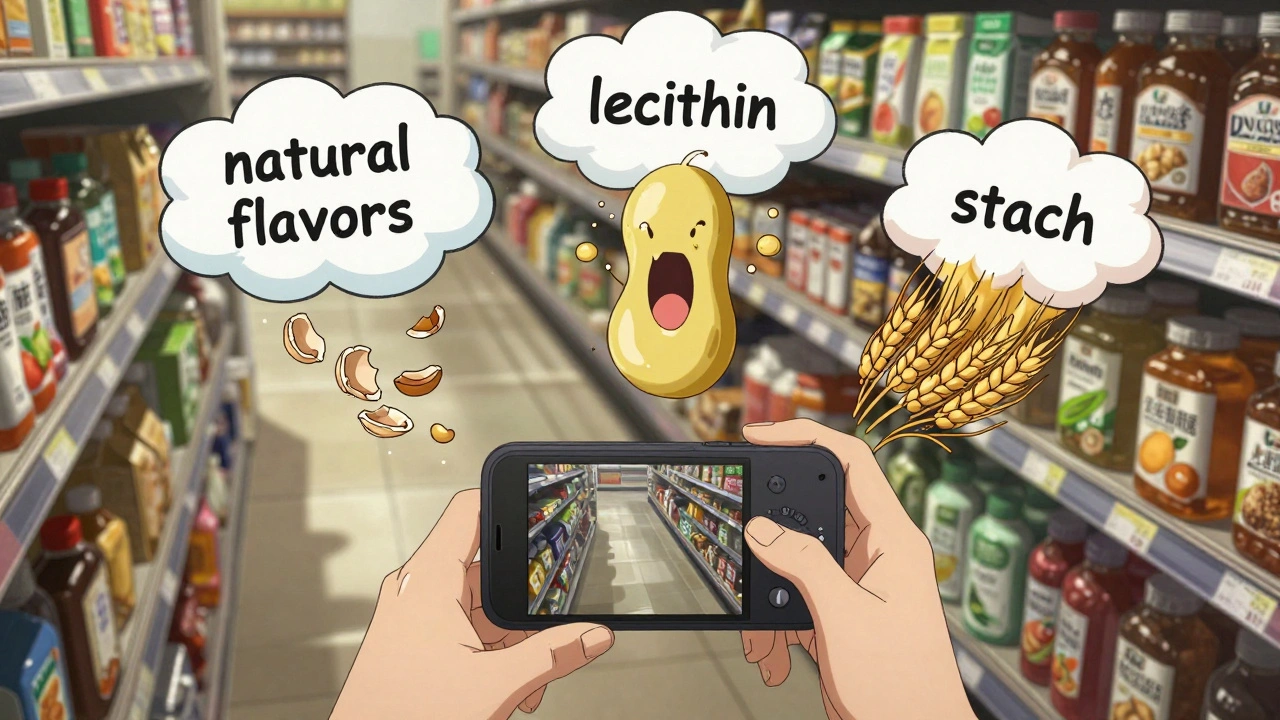
Watch out for vague terms like "natural flavors," "spices," or "starch." These can hide milk, soy, or wheat. If you’re unsure, don’t guess. Call the company or check their website. Most major brands now list full ingredient details online, including allergen info.
"May Contain" Labels Are Not Reliable
You’ve seen them: "May contain traces of peanuts," or "Produced in a facility that also processes tree nuts." These are voluntary statements. Companies use them to cover themselves legally, not to help you stay safe. And they’re everywhere - on about 25% of packaged foods.
Here’s what most people get wrong: they think "may contain" means the allergen was added on purpose. It doesn’t. It means there’s a chance of cross-contact during manufacturing. That’s still dangerous if you’re highly allergic. A 2022 study found that 63% of consumers mistakenly believe "may contain" means the product intentionally includes the allergen. That misunderstanding leads to bad decisions.
Don’t rely on these statements. If you’re allergic to peanuts, and you see "may contain peanuts," treat it like it has peanuts. Period. Even if you’ve eaten the same product before, don’t assume it’s safe. Formulas change. Suppliers change. Factories change. In 2022, FARE reported that 28% of allergic reactions happened because the product had been reformulated without the consumer realizing it.

Medications Don’t Have to Tell You What’s Inside
This is the part most people don’t know - and it’s terrifying.
Food labels are tightly regulated. Medicine labels are not. Prescription pills, over-the-counter drugs, and even topical creams can contain allergens like lactose (from milk), peanut oil, soy lecithin, or gelatin (from animals) - and they don’t have to say so on the bottle.
The FDA doesn’t require manufacturers to list inactive ingredients as allergens. That means your asthma inhaler might have soy. Your painkiller might have lactose. Your cream might have egg derivatives. And you won’t know unless you ask.
Pharmacists are your best ally here. Always ask: "What are the inactive ingredients in this?" And don’t accept "it’s just filler." Ask for the full list. Many pharmacies have printed sheets or digital access to the full prescribing information. Some even let you scan a QR code on the bottle to see the full ingredient list.
And here’s another trap: generic drugs. Just because you’ve taken the brand-name version safely doesn’t mean the generic is safe. Different manufacturers use different fillers. A pill that was fine last month might be dangerous this month if your pharmacy switched suppliers. Always check the label every time you fill a prescription - even if it’s the same medicine.
How to Build a Label-Reading Routine
Reading labels quickly and accurately takes practice. Here’s a simple, repeatable system:
- Start with the "Contains" statement. If it’s there, scan it first. If your allergen is listed, stop. Don’t buy it.
- Scan the ingredient list. Look for your allergen in parentheses. Watch for sneaky names: casein = milk, albumin = egg, hydrolyzed vegetable protein = soy or wheat.
- Check for "may contain" warnings. Treat them as red flags. If you’re highly allergic, avoid anything with these.
- For medications, always ask your pharmacist. Don’t assume. Don’t guess. Ask for the full list of inactive ingredients.
- Double-check every time. Even if you’ve bought it before. Ingredients change. Always.
With practice, this takes less than 20 seconds per product. Most people who manage food allergies say it becomes second nature after a few weeks. The key is consistency. One skipped check can lead to a reaction.
What to Do When You Find a Problem
If you find a product with missing or incorrect allergen labeling, report it. The FDA encourages consumers to file reports through their MedWatch system. You can also contact the company directly. Many have dedicated allergen hotlines.
For medications, report the issue to your pharmacist and your doctor. If you had a reaction, make sure it’s documented in your medical record. This helps prevent others from being exposed to the same risk.
Also, consider using apps like AllergyEats’ Scan feature. Launched in early 2024, it uses your phone’s camera to read ingredient lists and highlight allergens in real time. Beta testers reported 92% accuracy. It’s not perfect, but it’s a powerful tool - especially when you’re in a hurry or dealing with complex labels.
Why This Matters Beyond Your Own Safety
Every time you read a label carefully, you’re not just protecting yourself. You’re helping the system improve. The more people report labeling errors, the more companies are forced to fix them. The more people ask pharmacists about inactive ingredients, the more pressure builds for better standards.
And the market is responding. The global "free-from" food market hit $68.3 billion in 2023. Companies are investing in better labeling, clearer packaging, and digital tools because consumers demand it. Your attention to labels is driving change.
It’s not just about avoiding a rash or a stomach ache. For many, it’s about avoiding anaphylaxis - a life-threatening reaction that can happen in minutes. That’s why this isn’t just a habit. It’s a survival skill.
Are all food allergens required to be listed on labels?
Yes, the nine major allergens - milk, eggs, fish, crustacean shellfish, tree nuts, peanuts, wheat, soy, and sesame - must be clearly listed on all packaged food products sold in the U.S. They must appear either in parentheses next to the ingredient or in a separate "Contains" statement. There are no exceptions based on quantity or product type.
Can I trust "may contain" warnings on food labels?
No. "May contain" statements are voluntary and not regulated. They indicate possible cross-contact during manufacturing, not intentional inclusion. For people with severe allergies, these products should be avoided. Never assume a product is safe just because it doesn’t list your allergen - if it says "may contain," treat it as contaminated.
Why aren’t allergens listed on prescription labels?
The FDA does not require manufacturers to list inactive ingredients as allergens on prescription or over-the-counter drug labels. Ingredients like lactose, peanut oil, or soy lecithin are considered "inactive" and aren’t subject to the same rules as food. This creates a dangerous gap. Always ask your pharmacist for the full list of inactive ingredients.
What are common hidden names for allergens in ingredients?
Common hidden names include: casein and whey (milk), albumin and ovalbumin (egg), hydrolyzed vegetable protein (soy or wheat), arachis oil (peanut), and lecithin (often soy or egg). Natural flavors and spices can also contain allergens. Always research unfamiliar terms or ask the manufacturer.
Should I check labels even if I’ve used a product before?
Yes. Ingredients can change without notice. A product you’ve safely used for years might switch suppliers, reformulate, or change manufacturing lines. FARE reports that 28% of allergic reactions happen because the product changed and the consumer didn’t check the label again. Always read the label every single time.
How can I check allergens in medications?
Ask your pharmacist for the full list of inactive ingredients. Many pharmacies provide printed sheets or digital access to the prescribing information. Some bottles now have QR codes that link to detailed ingredient lists. Never rely on the bottle alone - always confirm with a professional.
Is sesame really that common in foods now?
Yes. Since January 2023, sesame must be labeled as a major allergen in the U.S. It’s found in everything from bread, hummus, and tahini to salad dressings, spice blends, and even some candies. Before 2023, it was often hidden under "spices" or "natural flavors." Now, it must be clearly named. About 1.1 million Americans are allergic to sesame, making it one of the most common food allergies.
Elliot Barrett
December 9, 2025 AT 13:23Wow, finally someone who gets it. I’ve had anaphylaxis twice because some idiot thought ‘natural flavors’ was vague enough to not list soy. Stop being lazy and read the damn label.
Maria Elisha
December 10, 2025 AT 15:34Y’all really still think ‘may contain’ is optional? Bro, I don’t care if it’s a candy bar or a pill-if it says ‘may contain nuts,’ I treat it like a bomb. Been there, nearly died.
Lisa Whitesel
December 11, 2025 AT 20:50Pharmacists are useless. I asked for inactive ingredients in my inhaler and they gave me a pamphlet from 2018. The FDA should mandate full allergen disclosure or we’re all just playing Russian roulette with our epinephrine pens
Larry Lieberman
December 13, 2025 AT 03:06Just downloaded that AllergyEats app 📱✅ and it flagged sesame in my hummus I’ve been eating for years. My life is changed. Also, why is no one talking about how sesame is in EVERYTHING now? 🤯
Simran Chettiar
December 14, 2025 AT 15:17It is not merely a matter of reading labels, but rather a profound existential engagement with the commodification of health in late capitalism, wherein the individual is forced to become a forensic scientist of their own survival, while corporate entities obfuscate through linguistic loopholes and regulatory arbitrage, rendering the very notion of informed consent a myth perpetuated by the illusion of choice
Anna Roh
December 16, 2025 AT 09:41So I just found out my thyroid med has lactose. I’ve been on it for 5 years. I’m not mad, just… disappointed.
om guru
December 18, 2025 AT 00:46Respectfully, the discipline of label reading is not a burden but a sacred practice of self-awareness. One must approach each ingredient with mindfulness and humility. The body remembers what the mind forgets. Always verify. Always honor your limits.
Katherine Chan
December 18, 2025 AT 23:38Y’all are doing amazing. Seriously. Reading labels isn’t just survival-it’s activism. Every time you call a company or report a mislabel, you’re making the world safer for the next person. Keep going 💪❤️
Shubham Mathur
December 20, 2025 AT 02:15Guys the real issue is nobody teaches this in school. I learned all this from my sister who had anaphylaxis at 8. We need mandatory allergy education in middle school. Like, right now. This isn’t optional knowledge. It’s basic human survival
Rich Paul
December 21, 2025 AT 06:34LMFAO so you’re telling me my Advil has lactose? Bro I’ve been popping 4 a day since 2017. My gut’s been screaming but I thought it was just ‘gut flora imbalance’ 😭
Katherine Rodgers
December 21, 2025 AT 11:42Wow. So the FDA lets drug companies lie to people but food companies have to spell it out? What a surprise. Next they’ll tell us oxygen is ‘not a medically necessary ingredient’
Guylaine Lapointe
December 22, 2025 AT 15:08My 7-year-old daughter has 12 allergies. I read every label like it’s a legal contract. I’ve called 37 companies. I’ve filed 5 FDA reports. I’ve cried over a granola bar. This isn’t a hobby. It’s my full-time job. And yes, I still miss things. And yes, it still terrifies me. But I won’t stop. Because if I do, she dies. And if you’re not doing this, you’re not just lazy-you’re complicit.