
When your stomach churns after eating, it’s easy to blame it on food. But is it a food allergy or just a food intolerance? The difference isn’t just semantic-it changes everything about how you eat, live, and stay safe. Both can cause bloating, cramps, or diarrhea, but one can kill you in minutes. The other just makes your day miserable.
What Happens in Your Body
A food allergy is your immune system going haywire. It sees a harmless protein-say, peanut or milk-as an invader. It fires off IgE antibodies, which trigger mast cells to dump histamine and other chemicals into your bloodstream. That’s why symptoms hit fast: hives, swelling, wheezing, vomiting, or even a drop in blood pressure. In severe cases, it’s anaphylaxis. This isn’t a guess. It’s a biological alarm system wired to react within minutes.
Food intolerance? That’s a digestive problem. Your body lacks the tools to break down certain foods. Lactose intolerance means you don’t make enough lactase enzyme. Without it, lactose slides undigested into your colon, where gut bacteria ferment it. The result? Gas, bloating, cramps, and diarrhea. It’s not your immune system. It’s your gut saying, “I can’t handle this.”
The timing tells the story. Allergy symptoms? Usually within 5 to 30 minutes. Intolerance? Often 30 minutes to several hours later. And here’s the key: you can eat a little bit of something you’re intolerant to. A splash of milk in coffee? Fine. A peanut? Even a crumb can trigger a life-threatening reaction if you’re allergic.
Common GI Symptoms-Side by Side
Both conditions can make you feel awful in the gut. But the patterns are different.
- Food allergy GI symptoms: Sudden vomiting, severe abdominal pain, explosive diarrhea-often within two hours. These usually come with other signs: swelling of the lips, itchy skin, coughing, or trouble breathing.
- Food intolerance GI symptoms: Gradual bloating, excessive gas, cramping, loose stools. No hives. No throat closing. No anaphylaxis. Just discomfort that builds slowly, often after a meal.
Take lactose intolerance. Around 65% of people globally have reduced lactase after infancy. In Australia, about 1 in 5 adults report trouble digesting dairy. Symptoms typically show up 30 minutes to 2 hours after milk, cheese, or ice cream. It’s not dangerous. But it’s disruptive.
Now contrast that with a peanut allergy. One study found that 7% of children with peanut allergy had vomiting as their first symptom. But in nearly half of those cases, it was followed by facial swelling or wheezing. That’s not just a tummy ache. That’s a medical emergency.
Testing: What Works and What Doesn’t
If you suspect a problem, testing matters. But not all tests are created equal.
For food allergies, the gold standard is a combination of three things:
- Skin prick test: A tiny bit of allergen is placed on your skin, then lightly pricked. A raised bump (wheal) of 3mm or more suggests allergy. It’s quick, cheap, and sensitive.
- Specific IgE blood test: Measures IgE antibodies in your blood. Levels above 0.35 kU/L are considered positive. But here’s the catch: a positive test doesn’t always mean you’ll react when you eat the food. Up to 50% of positive results are false positives.
- Oral food challenge: Done in a clinic under medical supervision. You eat increasing amounts of the suspected food while being watched. This is the only way to confirm a true allergy. If you’re still breathing and not breaking out in hives after eating a full serving? You likely aren’t allergic.
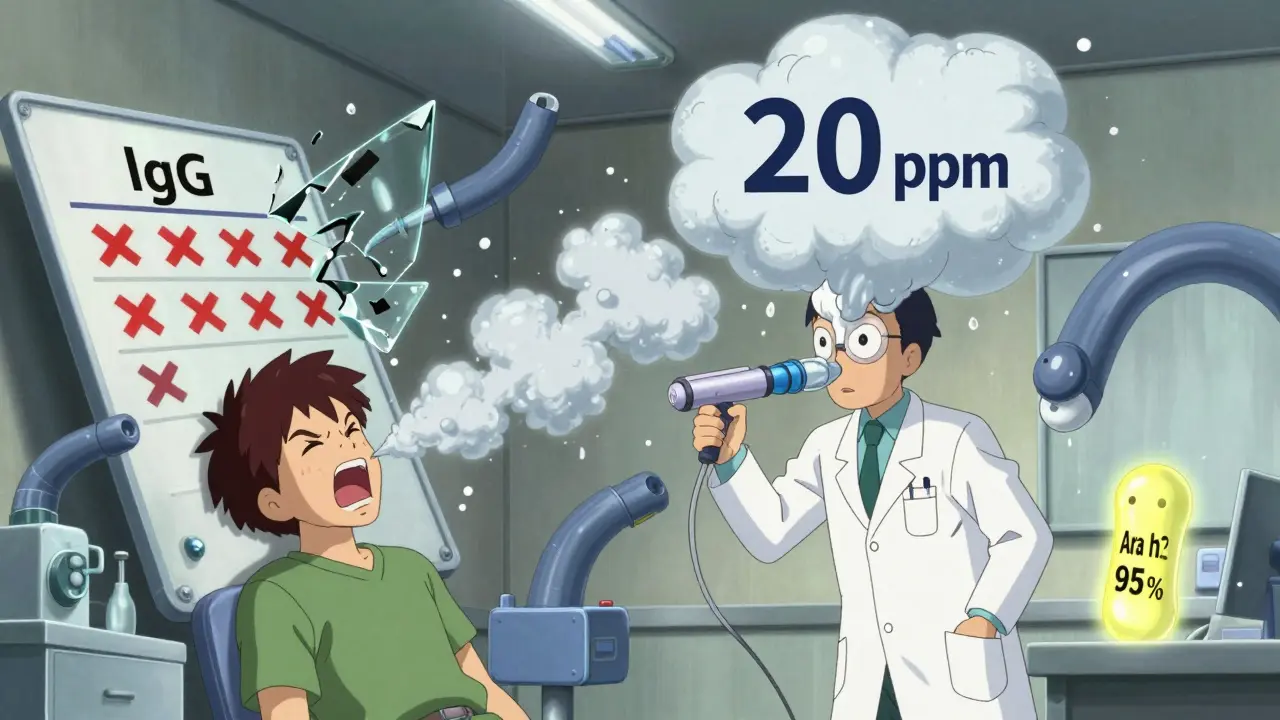
Component-resolved diagnostics are newer. For peanut allergies, testing for Ara h 2 protein levels above 0.23 kU/L predicts real allergy with 95% accuracy. That’s a game-changer for avoiding unnecessary fear.
Now for intolerances. No IgE test will help. Instead:
- Lactose intolerance: Hydrogen breath test. You drink a lactose solution. Your breath is tested every 15-30 minutes. A rise of 20 ppm in hydrogen means your body didn’t digest it. Sensitivity is 95%. But small intestinal bacterial overgrowth (SIBO) can cause false positives.
- Celiac disease: Not an intolerance-it’s an autoimmune disorder. Test for tissue transglutaminase IgA antibodies. If it’s above 10 U/mL, you need a biopsy. The damage to your small intestine (Marsh 3 classification) confirms it.
- Non-celiac gluten sensitivity: No test exists. You must eliminate gluten for 2-6 weeks, then reintroduce it. If symptoms return? Likely sensitive. But rule out celiac and wheat allergy first.
Here’s the warning: avoid IgG blood tests marketed as “food sensitivity” panels. These test for antibodies your body makes after eating-something everyone does. The American Academy of Allergy, Asthma & Immunology says these tests are unproven. Sensitivity? Below 30%. Specificity? Under 45%. They cause more harm than good, leading to unnecessary diets and anxiety.
What You Should Do Next
If you think you have a food issue, don’t self-diagnose. Cutting out whole food groups without knowing why can lead to nutrient gaps-especially in kids or older adults.
Start with a food and symptom diary. Write down everything you eat and how you feel. Look for patterns. Did symptoms happen after dairy? After wheat? After processed meats with sulfites?
Then see a doctor. A GP can refer you to a gastroenterologist or allergist. Rule out other conditions first: irritable bowel syndrome (IBS), inflammatory bowel disease (IBD), or acid reflux. A 2023 study found that 80% of people who thought they had a food intolerance actually had something else.
For suspected allergies: Get tested properly. Don’t skip the oral challenge. A positive skin test alone isn’t enough.
For suspected intolerances: Try elimination under guidance. Don’t go gluten-free just because you feel bloated. You might be missing out on fiber and B vitamins-and you might not even need to.

Managing Life After Diagnosis
If you have a food allergy: Strict avoidance is non-negotiable. Read every label. The FDA now requires the top nine allergens to be clearly listed: milk, eggs, fish, shellfish, tree nuts, peanuts, wheat, soy, and sesame. Carry two epinephrine auto-injectors (EpiPen) at all times. No exceptions. Even if past reactions were mild, the next one could be fatal.
If you have lactose intolerance: You don’t need to quit dairy entirely. Most people can handle up to 12 grams of lactose (about 1 cup of milk) spread through the day. Hard cheeses and yogurt with live cultures are often well tolerated. Lactase enzyme supplements taken before meals can help too.
For sulfite sensitivity: Avoid wine, dried fruit, and processed potatoes. Check labels. If it says “contains sulfites,” skip it if you’re sensitive.
For celiac disease: Gluten-free is mandatory. Not “mostly.” Not “sometimes.” Every bite counts. Cross-contamination in kitchens, shared toasters, or even soy sauce can trigger damage.
What’s on the Horizon
Science is getting smarter. A 2024 study in Nature Communications identified specific blood metabolites that distinguish non-celiac gluten sensitivity from IBS with 89% accuracy. That could mean a blood test for gluten sensitivity within the next few years.
Basophil activation tests are also being studied. These look at how immune cells react to food proteins-offering a more precise way to predict real reactions than IgE alone.
For now, the message is clear: Don’t guess. Get tested. Know the difference. Your gut-and maybe your life-depends on it.
Can food intolerance turn into a food allergy?
No. Food intolerance and food allergy are fundamentally different mechanisms-one is digestive, the other immune. Having lactose intolerance won’t cause you to develop a milk allergy. But someone with a food allergy can develop new allergies over time. The conditions don’t convert into each other.
If I react to gluten, do I have celiac disease?
Not necessarily. Reactions to gluten can be from three different things: celiac disease (an autoimmune condition), wheat allergy (an IgE-mediated allergy), or non-celiac gluten sensitivity (a poorly understood intolerance). You need blood tests and possibly a biopsy to know which one you have. Self-diagnosing as celiac without testing can mask the real issue.
Are at-home food sensitivity tests reliable?
No. Tests that measure IgG antibodies against foods are not scientifically valid. IgG antibodies simply show you’ve eaten the food recently-they don’t indicate an allergy or intolerance. These tests have a high rate of false positives and are not recommended by any major medical group. Stick to proven methods like elimination diets or clinical testing.
Can you outgrow a food allergy?
Yes, some can. About 80% of children outgrow milk, egg, wheat, or soy allergies by adolescence. Peanut, tree nut, fish, and shellfish allergies are less likely to be outgrown-only about 20% of children do. Adults rarely outgrow food allergies. Testing should always be done under medical supervision, even if you think you’ve outgrown it.
Is it safe to eat trace amounts of an allergen if I’ve never reacted before?
No. Even if you’ve eaten the food before with no reaction, or only had a mild one, you can still have a severe reaction next time. Allergic reactions are unpredictable. That’s why strict avoidance and carrying epinephrine are essential for anyone diagnosed with a food allergy. Never test your limits.
Why do some people react to dairy but not cheese?
Because cheese has less lactose. During fermentation and aging, bacteria break down lactose into simpler sugars. Hard cheeses like cheddar or parmesan contain very little lactose-often less than 0.1 gram per serving. Yogurt with live cultures also helps digest lactose. So you can tolerate cheese or yogurt but not milk-that’s classic lactose intolerance.
Donna Zurick
March 5, 2026 AT 06:22Just had my first epinephrine shot last year after a surprise peanut reaction. I thought I was just 'sensitive' until the ER doc said 'you were one minute from cardiac arrest.' Now I carry two EpiPens everywhere. Even in my purse when I go to the gym. Don't be that person who says 'it's probably fine.' It's not.
Food intolerance? I get bloated from dairy. Fine. I just skip milk. But allergy? That's a whole different life.
Stop self-diagnosing. Get tested.
Alex Brad
March 5, 2026 AT 07:24Oral food challenge is the only real test. Skin prick and IgE blood tests are just screening tools. Too many people panic over a positive result without confirmation. I've seen people eliminate entire food groups based on a blood test alone. That's not health. That's fear.
Renee Jackson
March 5, 2026 AT 15:53Thank you for this comprehensive and clinically accurate breakdown. It is imperative that individuals suffering from gastrointestinal distress do not self-prescribe dietary restrictions without professional guidance. Nutritional deficiencies, particularly in vulnerable populations such as children and the elderly, can result from unwarranted elimination diets. A structured approach involving a food-symptom diary, medical evaluation, and evidence-based diagnostic testing remains the gold standard of care.
RacRac Rachel
March 6, 2026 AT 15:00Ugh I used to think I had a gluten allergy because I got bloated after pasta 😅 Then I found out I just have SIBO and gluten was just the scapegoat. The IgG tests are a SCAM. I spent $300 on one and got 17 'sensitivities'... turned out I just needed to eat more fiber and stop chugging kombucha. 🙃
Also-hard cheese is my BFF now. Who knew cheddar was basically lactose-free? 🧀❤️
Jeff Card
March 6, 2026 AT 22:54I appreciate how clear this is. I had a friend who got diagnosed with a peanut allergy after a single mild reaction, but never did the oral challenge. She’s been terrified of every restaurant since. I wish she’d known that a positive skin test doesn’t always mean you’re allergic. It’s so easy to get caught in a cycle of fear when the science isn’t explained properly.
Tobias Mösl
March 8, 2026 AT 09:49Let me guess-the FDA 'requires' allergens because Big Pharma and Big Food are in bed together. They want you scared. They want you buying expensive 'allergen-free' junk that costs 3x more. They want you dependent on epinephrine pens that cost $700 a pop.
Here’s the truth: 90% of 'food allergies' are psychosomatic. You think you're allergic because you read about it online. The real cause? Gut dysbiosis from processed foods and antibiotics. The solution? Stop eating crap and take probiotics. No test needed.
And don't even get me started on 'celiac disease.' That's just a manufactured diagnosis to sell gluten-free bread. Real food has gluten. Your body evolved to digest it. You're weak if you can't handle it.
Mariah Carle
March 9, 2026 AT 08:20Isn't it fascinating how our bodies are mirrors of our modern disconnection from natural rhythms? We've replaced ancestral diets with lab-engineered carbohydrates, then blamed the body for its inability to digest synthetic overload. The immune system doesn't 'misfire'-it's screaming for homeostasis. Lactose intolerance? A return to evolutionary truth. Gluten sensitivity? A cry for real, unprocessed wheat.
We've turned biology into a diagnostic industry. But the answer isn't more tests. It's deeper listening.
What if the food isn't the enemy? What if we are?
Justin Rodriguez
March 10, 2026 AT 07:45I work in a GI clinic. We see so many people who’ve eliminated entire food groups because of a positive IgG test. Then they come in malnourished. One guy stopped eating all grains, dairy, eggs, and legumes because the test said he was 'sensitive' to all of them. He lost 30 pounds in 3 months. His vitamin D was below 10. B12 was nonexistent.
Don’t trust the internet. Talk to a real doctor. Get the right tests. You don’t need to be afraid of food. You just need to know what’s actually wrong.
Megan Nayak
March 10, 2026 AT 15:38Oh wow, another mainstream medical propaganda piece. Let me guess-your 'gold standard' is funded by pharmaceutical companies? IgE testing? Oral challenges? Epinephrine pens? All profitable. Meanwhile, the real science is buried.
Studies show IgG antibodies correlate with tolerance-not sensitivity. The AAAAA (American Academy of Allergy, Asthma & Immunology) is owned by drug manufacturers. They profit from lifelong fear, not cures.
And why do they ignore gut microbiome testing? Why no mention of leaky gut? Why no talk about glyphosate in wheat? This isn't science. It's corporate control dressed in a lab coat.
Divya Mallick
March 11, 2026 AT 23:01Western medicine is a colonial scam. In India, we’ve always known food reactions are tied to doshas, not IgE. You think a blood test in a sterile American lab can capture the complexity of Ayurveda? No. You’re reducing centuries of holistic wisdom to a single biomarker.
Why do you ignore turmeric? Why ignore ginger tea? Why ignore fasting? Your 'epinephrine pens' are just Band-Aids on a system that’s rotting from processed sugar and corporate greed.
Real healing is not in a clinic. It’s in ancestral knowledge. You’re not allergic-you’re poisoned by capitalism.
Pankaj Gupta
March 13, 2026 AT 18:41I appreciate the balanced approach in this post. While I respect the need for rigorous diagnostics, I also believe that personal experience matters. Many people find relief through elimination diets even without formal testing. The key is doing it thoughtfully-with medical supervision, not self-imposed restriction.
And yes, IgG tests are useless. I’ve seen too many patients waste money on them. The real breakthrough is in functional medicine approaches that look at gut health holistically, not just antibody levels.
Callum Duffy
March 15, 2026 AT 11:04Well-structured and clinically sound. I particularly appreciate the emphasis on the oral food challenge as the definitive diagnostic tool. Too often, patients are left with ambiguous results and no clear path forward. The distinction between intolerance and allergy is not merely academic-it has profound implications for quality of life and safety.
Also, the point about avoiding IgG testing is critical. The commercialization of unvalidated diagnostics is a significant public health concern. Thank you for providing clarity in a space rife with misinformation.