
When your skin feels tight, itchy, and constantly dry, it’s not just about being uncomfortable-it’s about your skin’s defense system breaking down. In eczema, the outer layer of skin, called the stratum corneum, acts like a brick wall. The bricks are dead skin cells, and the mortar holding them together is made of lipids: mostly ceramides, along with cholesterol and fatty acids. In healthy skin, this mortar is perfectly balanced: 50% ceramides, 25% cholesterol, and 15% fatty acids. But in eczema, that balance is shattered. Ceramide levels drop by 30-50%, and the types of ceramides change, leaving gaps in the wall. That’s why water escapes easily, irritants get in, and inflammation follows.
Why Ceramides Are the Missing Piece
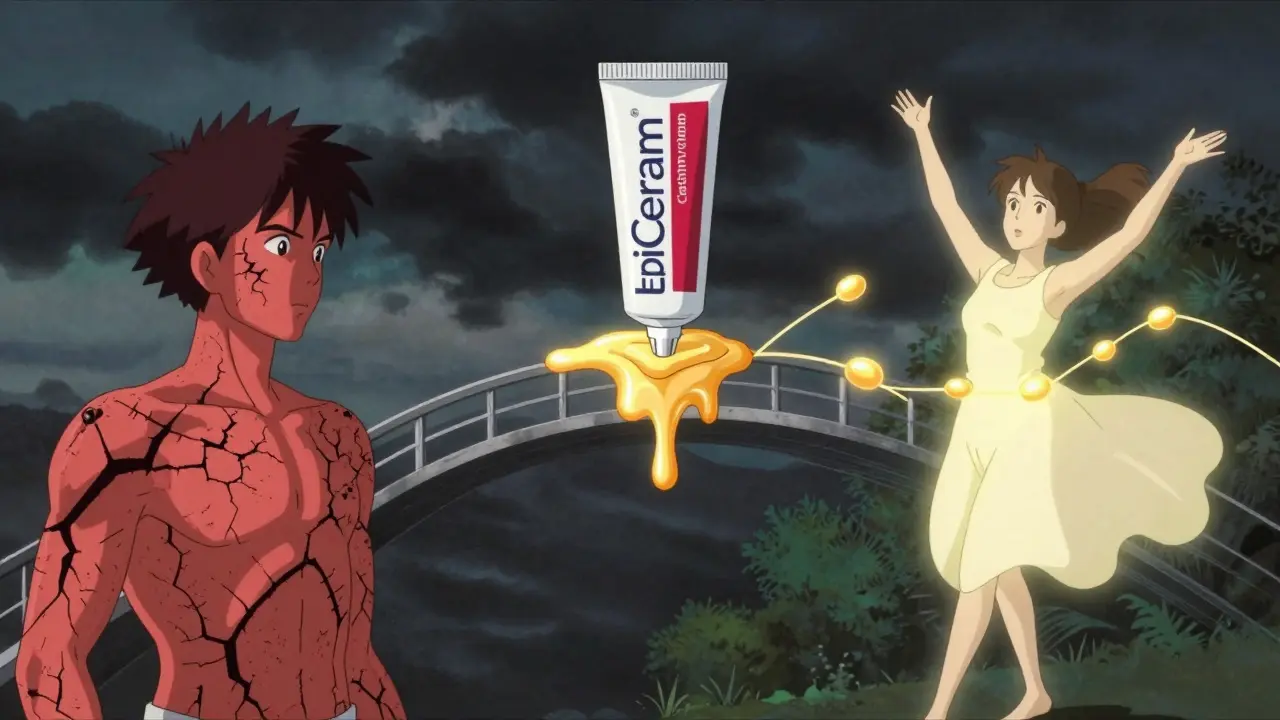
Ceramides aren’t just another ingredient on a label. They’re the glue that holds your skin together. In people with eczema, the body doesn’t make enough of the right kinds-especially ceramide 1. Instead, it produces shorter-chain versions like NP(18) and AP(18), which don’t form strong barriers. This isn’t a side effect of eczema-it’s one of the root causes. Studies show that when ceramides are restored, transepidermal water loss (TEWL) drops by 35-50%, meaning your skin stops drying out so fast.Not all moisturizers are built the same. Traditional ones like petrolatum or mineral oil just sit on top of the skin like a plastic wrap. They reduce water loss temporarily but don’t fix the broken mortar. True barrier repair needs the full lipid trio in the exact 3:1:1 ratio. Products like EpiCeram® and TriCeram® were developed based on this science. They don’t just hydrate-they rebuild. Clinical trials show they reduce redness and itching faster than regular lotions, especially over 4-6 weeks of daily use.
But here’s the catch: many over-the-counter products claim to have ceramides but don’t deliver enough-or the wrong kind. A 2021 review found that physiological ceramide formulations repair the barrier 40% better than petrolatum-based creams. So if you’ve tried a few moisturizers and nothing changed, it might not be you-it might be the product.
The Soak and Seal Method: Your Daily Ritual
Bathing can make eczema worse-or better. It all depends on how you do it. The gold standard is called "soak and seal." Here’s how it works:- Fill the tub with lukewarm water-no hotter than 90°F (32°C). Hot water strips away natural oils and makes irritation worse.
- Soak for 10-15 minutes. This lets water sink into the skin, plumping up the cells.
- Pat your skin gently dry. Don’t rub. Leave it slightly damp.
- Within 3 minutes, apply your ceramide cream or ointment. Damp skin absorbs it 50-70% better than dry skin.
This simple routine is backed by research from the Journal of the American Academy of Dermatology. One study showed that patients who followed this method saw a 40% improvement in skin hydration after just two weeks. Skipping the damp application? You’re wasting the product.
Choose your cleanser carefully, too. Avoid soaps with sodium lauryl sulfate (SLS) above 0.5%. Even mild cleansers with high SLS can spike TEWL by 25-40% within an hour. Look for pH-balanced cleansers labeled "fragrance-free" and "for sensitive skin." Some even contain ceramides themselves, which helps during the wash.

Prescription vs. Over-the-Counter: What Actually Works
There’s a big difference between what your dermatologist prescribes and what you find at the drugstore. Prescription barrier repair products like EpiCeram® and TriCeram® are classified as medical devices by the FDA. That means they had to prove they actually restore the skin barrier-not just make it feel softer.TriCeram® improved skin hydration by 30% more than standard emollients in moderate-to-severe eczema patients. EpiCeram® reduced itching and flaking so effectively that one case study showed a patient cutting steroid use from daily to once a week after eight weeks. These products cost $25-$35 for a 200g tube. That’s 200-300% more than a regular moisturizer.
But you don’t need to spend that much to get results. CeraVe, a popular OTC brand, contains ceramides in the right ratio and is backed by over 9,000 reviews on Trustpilot, with 68% of 5-star ratings mentioning "barrier repair." It’s not as potent as prescription formulas, but for mild to moderate eczema, it’s a solid choice. The key is consistency. Apply it twice a day, every day, for at least four weeks. Don’t expect miracles after three days.
What Users Really Say
On Reddit’s r/eczema community, over 1,200 users shared their experiences with ceramide products over a year. Nearly 80% said they saw less itching and dryness within 2-4 weeks. One user, u/EczemaWarrior, wrote: "After trying 10+ moisturizers, EpiCeram reduced my nightly scratching from 8-10 times to 1-2 times within 3 weeks."But not everyone had luck. On Amazon and WebMD, 15% of negative reviews said ceramide creams "didn’t work during bad flares." That’s true-they’re not meant to replace steroids during acute outbreaks. They’re for maintenance. Think of them like brushing your teeth: you don’t wait until you have a cavity to start.
Common complaints? "Too greasy" (27% of negative CeraVe reviews) and "too slow" (15%). If you’re using a thick ointment and hate the feel, try a lighter lotion version. Some brands now offer non-greasy gels with ceramides, which work just as well.
When to Expect Results-and When to Adjust
You won’t wake up with perfect skin after one application. Barrier repair takes time. Clinical trials show noticeable improvement after 21-28 days. That’s because your skin needs to rebuild its lipid layers from the inside out. If you stop after two weeks, you’ll give up too soon.During a flare, apply the ceramide product three times a day. Once things calm down, stick to twice daily. If you’re still itchy after six weeks, check the product label. Does it list specific ceramide types (like Ceramide NP, AP, EOP)? If not, it might not have enough active ingredients. Talk to your dermatologist about switching to a prescription-grade formula.
Also, don’t forget humidity. In dry climates like Melbourne’s winter, air moisture drops below 30%. That makes barrier repair harder. Using a humidifier at night can help your skin hold onto moisture better, especially when paired with ceramide application.
The Bigger Picture
Barrier repair isn’t a trend-it’s the future of eczema care. Dermatologists are now recommending ceramide-dominant emollients as first-line maintenance therapy. The European Academy of Dermatology says they should be used for all severities of eczema. Why? Because fixing the barrier reduces inflammation at its source. Less inflammation means less need for steroids, antibiotics, and immunosuppressants.And it’s getting smarter. New research is testing biomarker-guided creams that match your exact ceramide deficiency. In early trials, these personalized formulas worked 30% better than standard ones. While they’re not available yet, they’re coming.
For now, the best thing you can do is stick to the basics: soak and seal daily, use a ceramide product with the right ratio, and be patient. Your skin isn’t broken beyond repair. It just needs the right materials-and time-to heal itself.
Lebogang kekana
March 2, 2026 AT 05:58Jessica Chaloux
March 2, 2026 AT 13:38Mariah Carle
March 2, 2026 AT 20:32Justin Rodriguez
March 2, 2026 AT 21:32Raman Kapri
March 3, 2026 AT 03:59Megan Nayak
March 3, 2026 AT 07:15Tildi Fletes
March 3, 2026 AT 17:11Siri Elena
March 4, 2026 AT 14:49Divya Mallick
March 4, 2026 AT 21:22Pankaj Gupta
March 6, 2026 AT 15:56RacRac Rachel
March 8, 2026 AT 03:44Jane Ryan Ryder
March 8, 2026 AT 23:28Callum Duffy
March 9, 2026 AT 04:34Levi Viloria
March 10, 2026 AT 13:01